
Certified materials
Exclusively grade 316L stainless steel or higher with CE marking. No cheap alternatives that rust through within five years.
Have a pellet stove installed with the utmost care? Get a quote in 5 steps.
Have a pellet stove installed with the utmost care? Get a quote in 5 steps.
Have a pellet stove installed with the utmost care? Get a quote in 5 steps.

Our services
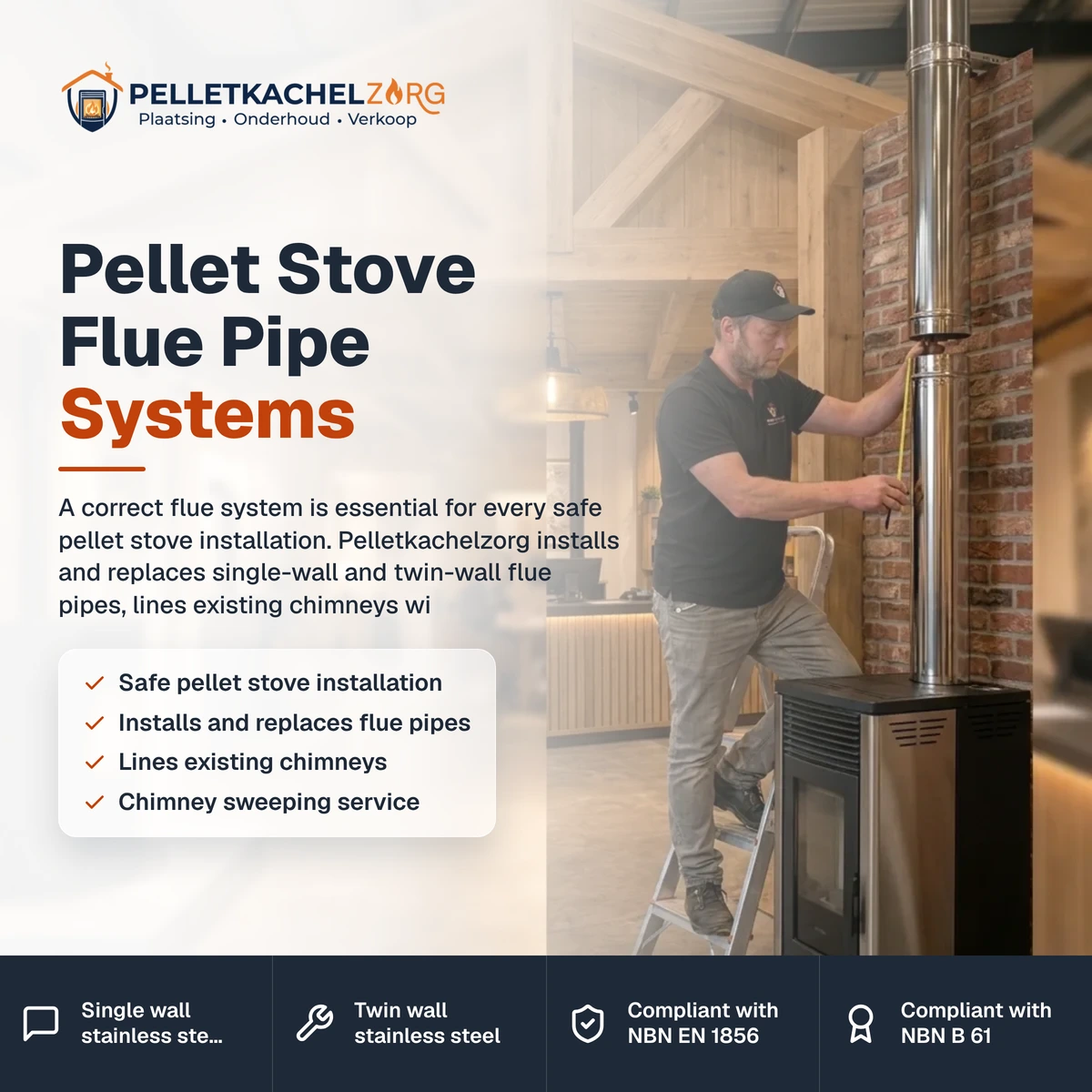
A correct flue system is essential for every safe pellet stove installation. Pelletkachelzorg installs and replaces single-wall and twin-wall flue pipes, lines existing chimneys with stainless steel, and ensures your flue meets all Belgian NBN standards. Active in Limburg, Flemish Brabant, De Kempen, and Dutch Limburg.
The flue system is not an afterthought, it is the heart of any pellet stove installation. A properly sized and correctly installed chimney flue achieves three key goals simultaneously: safe evacuation of flue gases (including carbon monoxide), sufficient draught for complete combustion (at least 10-12 Pascal), and optimal efficiency from your pellet stove.
A poorly constructed flue causes a domino effect of issues. Insufficient draught results in incomplete combustion, generating more soot, which clogs the chimney pipe faster, reducing the draught even further. In the worst case scenario, carbon monoxide can leak into your home, an invisible, odourless gas that causes casualties every year.
"I have seen €4,000 pellet stoves underperform due to an incorrectly sized flue system. And I have seen budget stoves run perfectly thanks to a properly installed flue. The flue pipe makes all the difference, literally."
Pelletkachelzorg handles the complete flue installation for your pellet stove, from advice and site survey to fitting and aftercare:
Installing new flue systems: twin wall stainless steel along the external wall or through the roof, fully compliant with Belgian NBN EN 1856-2 standards
Lining existing chimneys: single wall stainless steel (flexible or rigid) through the existing brick chimney stack. Saves you €600-1,500 compared to a brand new flue system
Flue replacement: for outdated, damaged, or non-compliant flues that no longer meet NBN standards
Pellet stove connection: T-piece, condensation drain, and inspection hatch for maintenance and cleaning
Chimney sweeping: as part of the annual service or as a standalone service. Read more in our article about chimney sweeping
Fitting anti-downdraught cowls: including rain cap and bird guards
The choice between single wall and twin wall depends on where the flue pipe is routed:
Suitable for installation inside an existing masonry chimney. The chimney stack protects the single wall flue pipe against temperature fluctuations and provides structural support. Supplied as a flexible liner (for chimneys with bends) or rigid sections (for straight chimneys). This is the most cost-effective option if you have a suitable chimney.
Single wall cost in existing chimney: €600 to €1,200
Mandatory when the flue does not run through a protective chimney stack: along an external wall, through an unheated loft, or through the roof without an existing chimney. The double wall with mineral wool insulation (25-50 mm) prevents condensation and keeps flue gas temperatures high enough for proper draught.
Twin wall cost along the facade: €1,000 to €2,000
Twin wall cost through the roof: €1,200 to €2,500
You can find more technical details and scenarios in our blog post on when a twin wall flue pipe is required.
No existing chimney stack? Then you have two options for your flue system:
Through the roof: most direct route, best draught, invisible from the outside. More complex installation, higher cost (€1,200-2,500)
Along the external facade: easier installation, lower cost (€1,000-2,000). Visible on the outside, may require local planning notification
Which option suits your home best depends on the roof structure, the location of the pellet stove, distance to neighbours, and aesthetic preference. We will advise you during a free home survey. Read a full comparison in our article on flue through the roof or external wall.
In Belgium, strict rules apply to flue gas evacuation for solid fuel appliances. Pelletkachelzorg knows these regulations inside out and applies them to every installation:
Termination above the ridge: the flue pipe must terminate at least 40 cm above the ridge of the roof
No wall outlets in Flanders: horizontal flue termination through the facade is not permitted for pellet stoves and other solid fuel burning appliances. Flue gases must be discharged vertically above roof level
Distance to openings: the flue outlet must be positioned at least 2 metres away from neighbouring windows, doors, and ventilation openings
Certified materials: the flue pipe must comply with NBN EN 1856-1 (single wall) or NBN EN 1856-2 (twin wall). In practice: grade 316L stainless steel or higher with CE marking
Clearance to combustibles: the required distance between the flue system and combustible materials is specified by the manufacturer on the CE performance label
Full regulatory details, including the NBN B 61-002 installation standard, can be found in our complete guide on flue regulations. Read a detailed explanation of all standards and certifications in our article on NBN standards for flue systems explained.
Do you have an existing masonry chimney? You can often reuse it by installing a flexible stainless steel liner. This is the most affordable solution (€600 to €1,200) and preserves the original look of your home.
However, the chimney stack must meet three core requirements:
Structurally sound: no major cracks, no risk of collapse, no severe damp issues
Sufficient height: the flue liner must be at least 4 metres long to guarantee adequate draught
Not shared: a pellet stove must never share a flue pipe with another heating appliance
We assess your chimney stack free of charge on site and give you honest advice on whether relining is viable or if a new twin wall flue system is the better choice. Find more details in our article about connecting a pellet stove to an existing chimney.
A flue pipe that does not comply with NBN standards carries serious risks:
Safety hazards: poor draught, smoke spillage, or carbon monoxide leaks into the home
Insurance issues: in the event of fire or damage, your insurer may refuse coverage if the flue installation is non-compliant
Warranty invalidation: pellet stove manufacturers require a fully compliant installation to honour warranty claims
Local authority enforcement: local councils can compel you to rectify a non-compliant flue pipe
Poor performance: an incorrectly sized flue lowers the efficiency of your pellet stove and causes draught problems
Unsure whether your current flue system meets standards? Pelletkachelzorg offers a free inspection during a site visit.
A flue pipe for pellet stoves must be swept at least once per heating season. Soot and fly ash narrow the passage, impair the draught, and present a serious chimney fire risk. At Pelletkachelzorg, chimney sweeping is included as standard in our annual maintenance service. If you prefer it as a standalone service, we can accommodate that too.
Signs that your flue system urgently needs sweeping: smoke smell indoors, lazy smoky flames, glass blackening quickly, or pressure differential error codes. If you smell smoke: stop burning immediately and call us.
Pelletkachelzorg exclusively works with certified flue pipes made of 316L stainless steel or higher, fully resistant to acidic condensates created during pellet combustion. Every flue pipe features a CE performance label detailing temperature class, pressure class, and corrosion resistance.
We provide a comprehensive guarantee on every flue system we fit. Cheaper pipes made of thinner steel or aluminium may save money initially, but cause costly corrosion, leaks, and full replacements within five years.

We offer a free on-site survey, assess your installation, and provide a custom quote. Certified materials and fully compliant installation.
Certified materials
Exclusively grade 316L stainless steel or higher with CE marking. No cheap alternatives that rust through within five years.
Free site visit
We assess your situation on-site for free and provide honest advice on the best flue pipe system for your home.
Warranty on every flue
We offer a full warranty on every flue pipe installation we perform, covering both materials and labour.
A single-wall flue inside an existing chimney costs €600 to €1,200. A twin-wall external flue along a facade costs €1,000 to €2,000, and through the roof €1,200 to €2,500. The exact price depends on length, roof penetrations, and job complexity.
Whenever the flue pipe does not run through a protective masonry shaft: along exterior walls, through unheated attics, or straight through the roof without a chimney. The insulated double wall prevents condensation and maintains proper draught.
Usually yes, by inserting an 80 mm or 100 mm stainless steel liner. The chimney must be structurally sound, at least 4 metres long, and not shared with another appliance. We assess this for free during an on-site visit.
No, not in Flanders. For solid fuel appliances, including pellet stoves, combustion gases must be discharged vertically via a flue pipe above roof level. Horizontal wall termination is not compliant with regulations.
At least 40 cm above the ridge for pitched roofs. For flat roofs, at least 1 metre above the roof surface. The terminal must also be placed at least 2 metres away from neighbouring doors and windows.
At least once per heating season. For intensive use, over 8 hours a day, sweeping twice a season is recommended. Chimney sweeping is included as standard in annual maintenance with Pelletkachelzorg.
Warning signs include recurring draught issues, smoke odours indoors, visible rust, aluminum or thin steel pipes instead of stainless steel, or horizontal wall outlets. Pelletkachelzorg inspects your flue for free during a site visit.
Grade 316L stainless steel or higher, resistant to acidic condensation produced during pellet combustion. Standard steel or aluminum corrodes within a few years. Flues must feature a CE performance label specifying temperature and corrosion ratings.
Flue installation, lining, and replacement in Limburg, Flemish Brabant, De Kempen, and Dutch Limburg.
Transforming your fireplace with a built-in pellet stove? Pelletkachelzorg specializes in installing pellet stove inserts and cassettes into existing fireplaces and mantels. We modify the flue, ensure proper ventilation, and perfectly calibrate your system. Active in Limburg, Vlaams-Brabant, and the Kempen region.
Reusing an existing chimney? A flexible stainless steel liner easily adapts an old flue for a modern stove.
Twin wall flues are used where temperature, clearance to materials, and external air are important factors.
A pellet stove requires a carefully selected flue system, with special attention to draft, condensation, bends, diameter and maintenance.
Looking to have a pellet stove installed by an experienced professional? Pelletkachelzorg handles complete pellet stove installation across Belgian Limburg, Dutch Limburg, and Flemish Brabant. From expert advice and measuring to flue installation, connection, and fine tuning, everything is managed seamlessly. Freestanding, insert, or hydro models.