
Complete Annual Service
We clean the burner pot, heat exchanger, and flue in a fixed order. You end up with a stove that remains safe and efficient.
Have a pellet stove installed with the utmost care? Get a quote in 5 steps.
Have a pellet stove installed with the utmost care? Get a quote in 5 steps.
Have a pellet stove installed with the utmost care? Get a quote in 5 steps.

 Written by Dries Nijs3 min read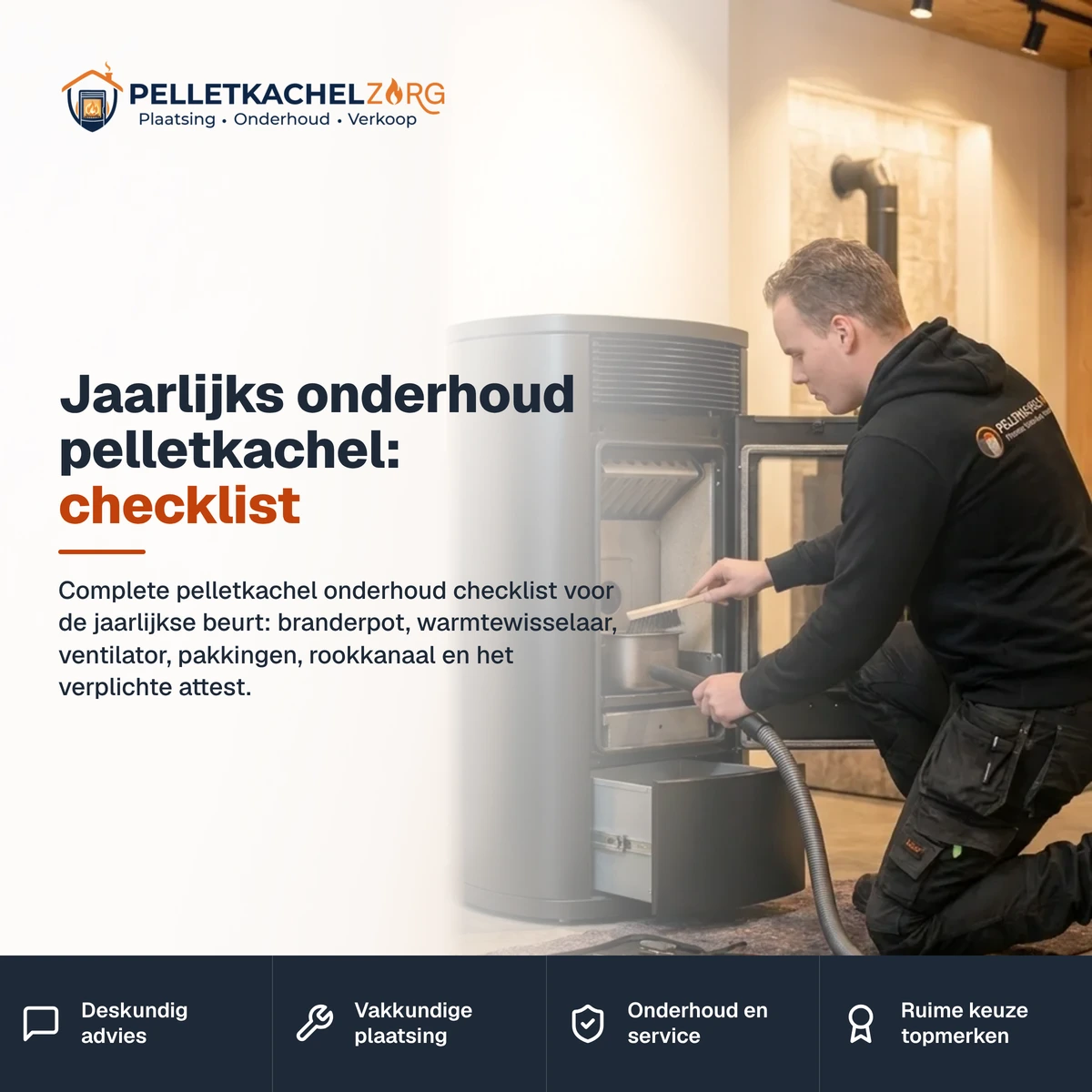
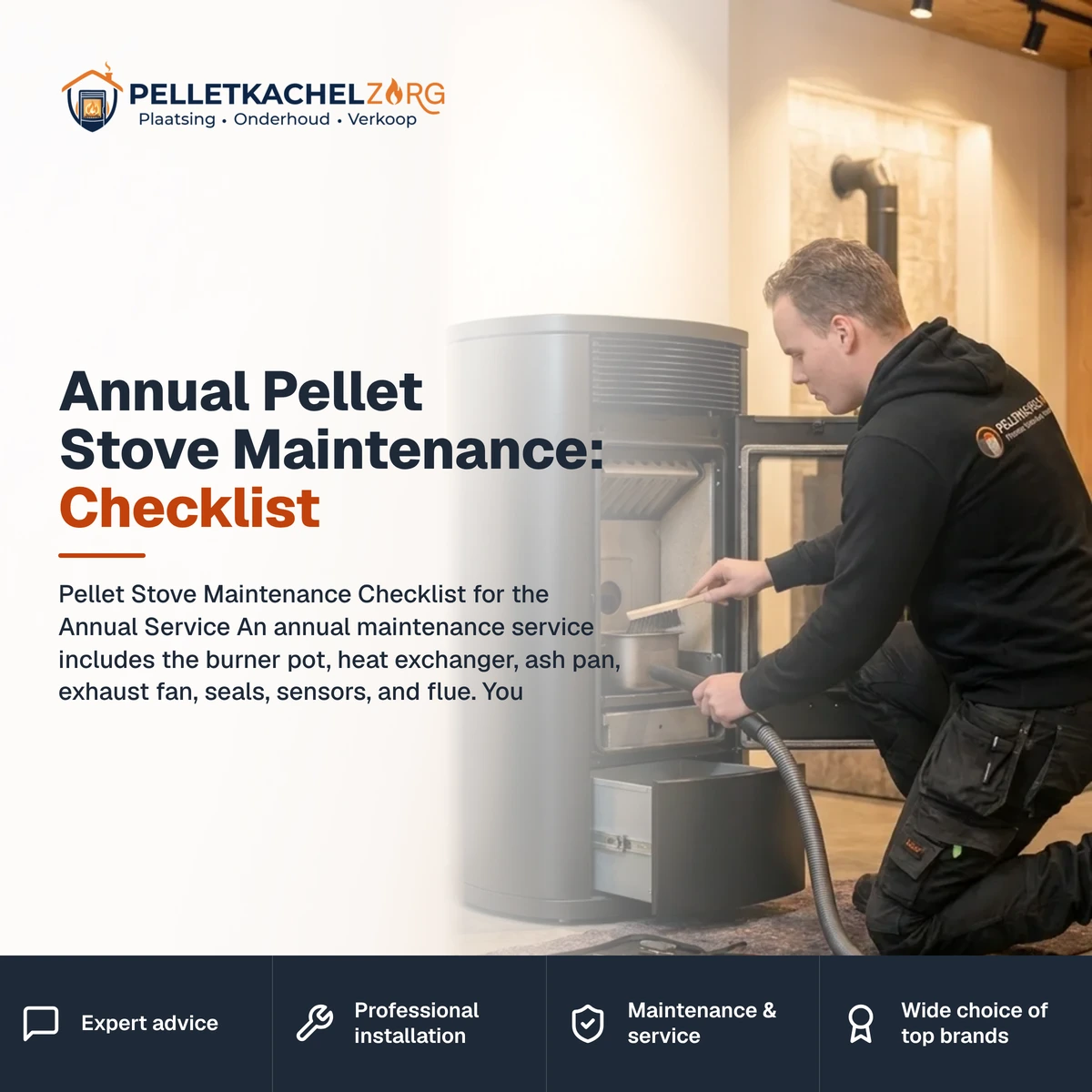
An annual maintenance service includes the burner pot, heat exchanger, ash pan, exhaust fan, seals, sensors, and flue. You can check off the light tasks yourself, while the heavy annual work and certification are for the professional.
Keep the certificate, as it counts towards your warranty and insurance.
A pellet stove maintenance checklist helps you complete the annual service thoroughly and in the correct order. During a comprehensive service, the burner pot, heat exchanger, ash pan, exhaust fan, seals, sensors, and flue are addressed.
Some tasks you can check off yourself, while others require a certified professional. At the bottom, you'll find a numbered checklist and a list of items to prepare. This ensures your stove burns safely, efficiently, and without issues, and you know exactly which action corresponds to which moment.
Divide the maintenance into two parts. You handle the light, recurring tasks in between, while the heavy annual work is for a professional with the right tools and certification.
This division keeps your costs low and your stove safe. Self-maintenance prevents ash buildup and dirty glass, while the professional reaches hidden parts that you can't see without disassembly. Skipping the annual service leads to soot buildup and reduced efficiency.
Check off daily and weekly tasks yourself, but have the heat exchanger, exhaust fan, and flue serviced annually by a professional.
Complete Annual Service
We clean the burner pot, heat exchanger, and flue in a fixed order. You end up with a stove that remains safe and efficient.
Certificate Included
After the service, you receive a maintenance certificate. This proves the cleaning for your warranty and fire insurance.
Certified Expertise
Our technicians know the common brands and error codes. They measure sensors and seals with the right tools.
Complete the service in a fixed order, from the combustion chamber to the flue. This prevents loose soot from entering already cleaned parts.
Allow the stove to cool completely and unplug it before starting.
Empty the ash pan and ash area, and remove the burner pot for cleaning.
Open the heat exchanger, clean the tubes, and vacuum the loosened soot.
Clean the flue channels and exhaust fan, checking for play or vibrations.
Inspect the seals around the door and ash pan hatch for hardness and leaks.
Check the door rope with the paper test and replace it if visibly worn.
Test the sensors, pressure switch, and electronics for correct values.
Have the flue swept and check for creosote, nests, and obstructions.
Conduct a test burn, check for safe operation, and issue the maintenance certificate.
Only check off each step when it's truly complete, as a partially cleaned heat exchanger or a forgotten sensor quickly triggers an error code. Note any specifics, like a worn rope or a ticking fan, so you can address them in the next service.
Prepare the materials in advance, so the service runs smoothly without needing to stop halfway. This is handy whether you're checking off tasks yourself or hosting the professional.
Ash vacuum with a metal reservoir and a heat-resistant hose.
Soft brush, a cobweb brush, and a set of screwdrivers.
Spare door rope, a seal kit, and heat-resistant glue.
The stove manual with the maintenance schedule for your model.
Dust mask, gloves, and an old cloth for the glass.
Always use an ash vacuum and never a regular vacuum cleaner, as fine ash can remain hot for a long time and damage your device. Only work when the stove is completely cold. This way, you can safely check off the checklist.
The order protects your stove and your lungs. Always work from the inside out, starting with the burner pot and heat exchanger, and only then the flue. This prevents soot from being moved to already cleaned parts.
If you want background information on each action, read the complete maintenance guide or follow the detailed cleaning step by step. How strict the schedule should be depends on your usage and pellets, as explained in how often you should perform maintenance.
An annual service is the minimum for most households. If you use the stove intensively or use lower-quality pellets, a second cleaning halfway through the season is often wise. Your manual provides the leading standard for your model.
Keep the maintenance certificate carefully, as it counts towards your factory warranty and fire insurance. In Belgium, insurers often request proof of cleaning after a chimney fire, and the rules vary by region and municipality. In the Netherlands, the approach varies by municipality and policy.
Why this document can be binding is explained in why a cleaning certificate is required. A complete picture of the service itself is found in what exactly happens during the annual service. Always consult your municipality, region, insurer, or manual as a binding source if in doubt.
A complete dossier makes a difference in case of damage. Besides the certificate, keep the invoice and replaced parts, like an old door rope. This shows that your pellet stove is maintained annually and according to the checklist.
If you want the annual maintenance with certification performed or your flue inspected, we are happy to assist. Request a quote or advice.
We are happy to help. Contact us without obligation.
The checklist includes the burner pot, heat exchanger, ash pan, flue channels, exhaust fan, seals, door rope, sensors, and flue. You check off the light tasks yourself and leave the heavy tasks and certification to a professional.
You can clean the ash pan, burner pot, glass, and reservoir yourself. Opening the heat exchanger, disassembling the exhaust fan, and sweeping the flue are better left to a professional, as they require tools, knowledge, and certification.
Expect about one to two hours with a professional, depending on your model and the level of dirt. If you do the light tasks yourself, it usually takes about half an hour. A heavily soiled stove or a long flue logically takes more time.
You keep the certificate because it proves your cleaning for your warranty and fire insurance. After damage or a chimney fire, the insurer often requests this proof. Without a certificate, you risk disputes over coverage or your warranty.