

Agricola
Agricola Pellets Bag 15kg - Enplus A1 - 6mm
4,6 kWh/kgNet calorific value
6 mmDiameter
0.7 %Ash content
≤ 10 %Moisture content
SpruceRaw material
ENplus A1Certification
€6.70€7.10incl. VAT
Have a pellet stove installed with the utmost care? Get a quote in 5 steps.
Have a pellet stove installed with the utmost care? Get a quote in 5 steps.
Have a pellet stove installed with the utmost care? Get a quote in 5 steps.

 Written by Dries Nijs4 min read
Buy pellets with a recognized label like ENplus A1 or DINplus. Such a label guarantees low ash and moisture content, enhancing efficiency and reducing malfunctions. Cheap pellets without a label often end up costing more.
Choose based on ash, moisture, and label, not the lowest price per bag.
Buy pellets with a recognized quality label like ENplus A1 or DINplus, as this is the most reliable way to purchase the best pellets. Such a label guarantees low ash content, low moisture content, and stable combustion value. This increases your stove's efficiency and reduces malfunctions. Cheap pellets without a label may seem economical but often end up costing more. Below, discover what to consider for quality and price.
Ash content below 0.7 percent, so less frequent cleaning
Moisture content below 10 percent for high combustion value
Diameter 6 mm and low fine dust, ensuring stable supply
Traceable origin and controlled production
Unknown ash content, often more clinkers and pollution
Variable moisture content, resulting in more smoke and less heat
More fine dust and crumbliness, causing malfunctions
No guarantee on composition or wood type
Choose pellets based on ash, moisture, and label, not the lowest price per bag.
ENplus A1
Agricola

Jaso Pellets
AKZ Premium Pellets
The ash content indicates how much non-combustible material remains after burning. ENplus A1 keeps this below 0.7 percent. Less ash means cleaner burning, a less polluted burner, and longer intervals for emptying the ash pan.
The moisture content determines how much energy is lost to evaporating water. Good pellets stay below 10 percent moisture. Dry pellets ignite more easily, produce a stronger flame, and result in less smoke and condensation in the flue.
The diameter may seem trivial, but it determines the feed through the auger. For most pellet stoves, 6 mm is the standard, though 8 mm is sometimes used. An incorrect size or excessive fine dust leads to irregular feeding and malfunctions.
The wood type affects the combustion value. Softwood pellets contain more resin and generally provide higher heat output. Hardwood pellets burn slower and may leave slightly more ash. Both work well as long as the label and stated values are accurate.
Finally, compare prices wisely. Calculate the cost per kilo, as a pallet with many bags may seem expensive but might not be. Quality pellets with more heat per kilo are often more economical than they initially appear.
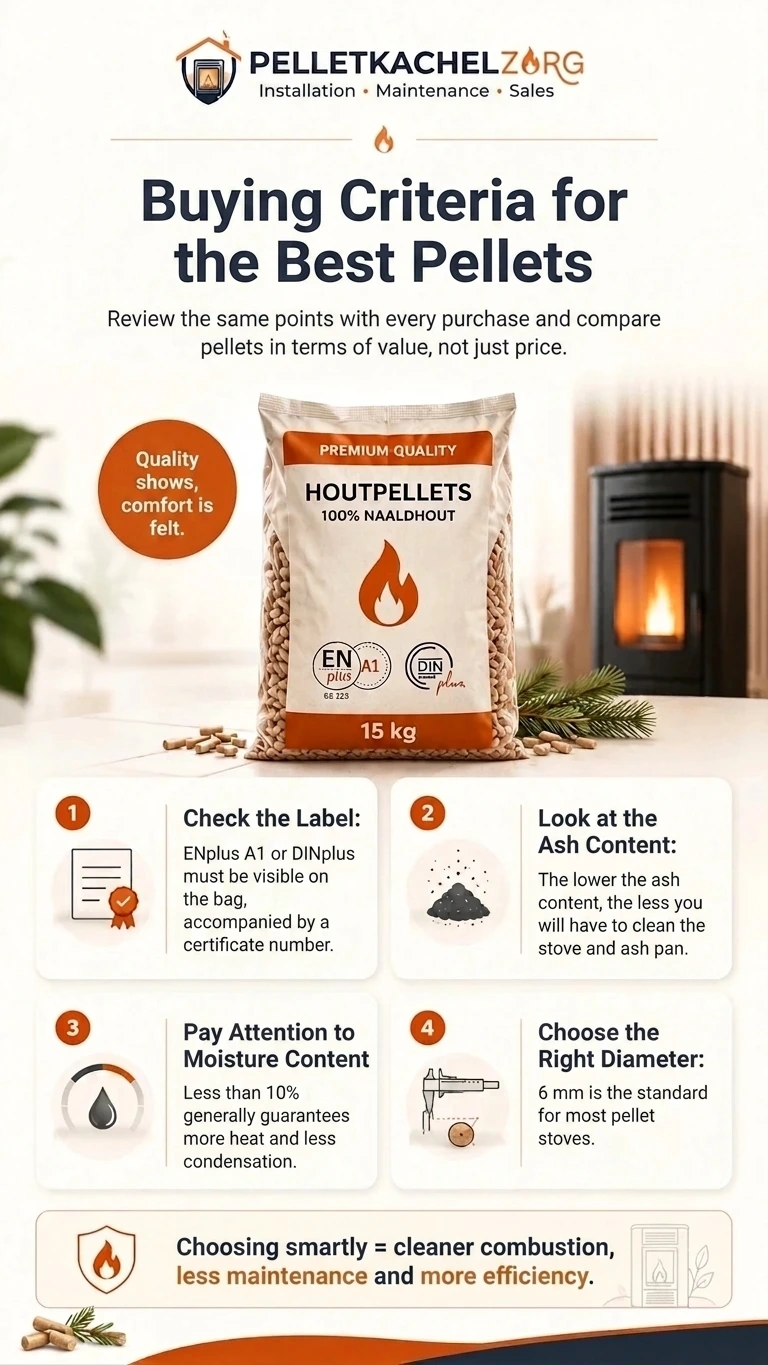
Review the same points with every purchase.
This way, you compare pellets fairly on value rather than just the price per bag.
Check the label, as ENplus A1 or DINplus is visibly marked on the bag with a certificate number.
Look at the ash content, as the lower it is, the less you need to clean the stove and ash pan.
Pay attention to the moisture content, as below 10 percent provides more heat and less condensation.
Choose the correct diameter, as 6 mm is the standard for most pellet stoves.
Evaluate the wood type, as softwood often provides higher combustion value and hardwood burns slower.
Compare the price per kilo of heat, not just the price per pallet.
Label ENplus A1 or DINplus with certificate number present
Ash content and moisture content listed on the packaging
Diameter 6 mm suitable for your pellet stove
Bags dry and undamaged, no loose sawdust at the bottom
A dry, covered place to store the supply
Cheap pellets often cost more because higher moisture and ash content reduce the combustion value. Your stove then consumes more pellets for the same heat. More ash also means more frequent cleaning and faster polluted parts.
The risk of malfunctions also increases. Excessive fine dust and crumbly pellets disrupt the auger and ignition. In the long run, you pay back in extra cleaning sessions and repairs, quickly negating the price advantage.
A garage, storage room, or dry cellar is usually suitable for storing pellets. Avoid damp places and direct rain. Do not buy more than you can store dry, as good storage protects the quality you paid for.
Always store pellets dry, as even quality pellets absorb moisture and crumble in a damp area. Place the bags on a pallet, not on a cold concrete floor. This keeps the combustion value intact. Read more tips on how to store wood pellets dry.
If you buy by the pallet, store the bags sealed until needed. A torn bag absorbs moisture and the pellets crumble into dust. This way, you lose part of the quality you paid for.
A label is a strong indication, not an absolute guarantee. Storage, transport, and the age of the bag also play a role. If you're unsure about the right fuel, compare options at choosing fuel for less smoke and better efficiency.
If you want to be sure of the right pellets and a well-adjusted stove, we are happy to help. Request a quote or advice.
The best pellets carry an ENplus A1 or DINplus label with a certificate number on the bag. This guarantees low ash and moisture content and a diameter of 6 mm, ensuring cleaner burning and higher efficiency.
Usually, yes. Quality pellets provide more heat per kilo and less ash. You'll use fewer and clean the stove less often, partially offsetting the higher price per bag.
For most pellet stoves, use pellets with a diameter of 6 mm. This is the standard for ENplus A1 and DINplus. Always check your device's manual for the correct size.
Bad pellets contain a lot of fine dust, crumble easily, and lack a recognized label. When burned, they produce more ash, more smoke, and a weaker flame. When in doubt, choose pellets with a visible quality label.