
Pre-Inspection of Chimney
We check the tightness, condition, and diameter of your existing chimney. This ensures you know if a liner is needed before anything is installed.
Have a pellet stove installed with the utmost care? Get a quote in 5 steps.
Have a pellet stove installed with the utmost care? Get a quote in 5 steps.
Have a pellet stove installed with the utmost care? Get a quote in 5 steps.

 Written by Dries Nijs4 min read
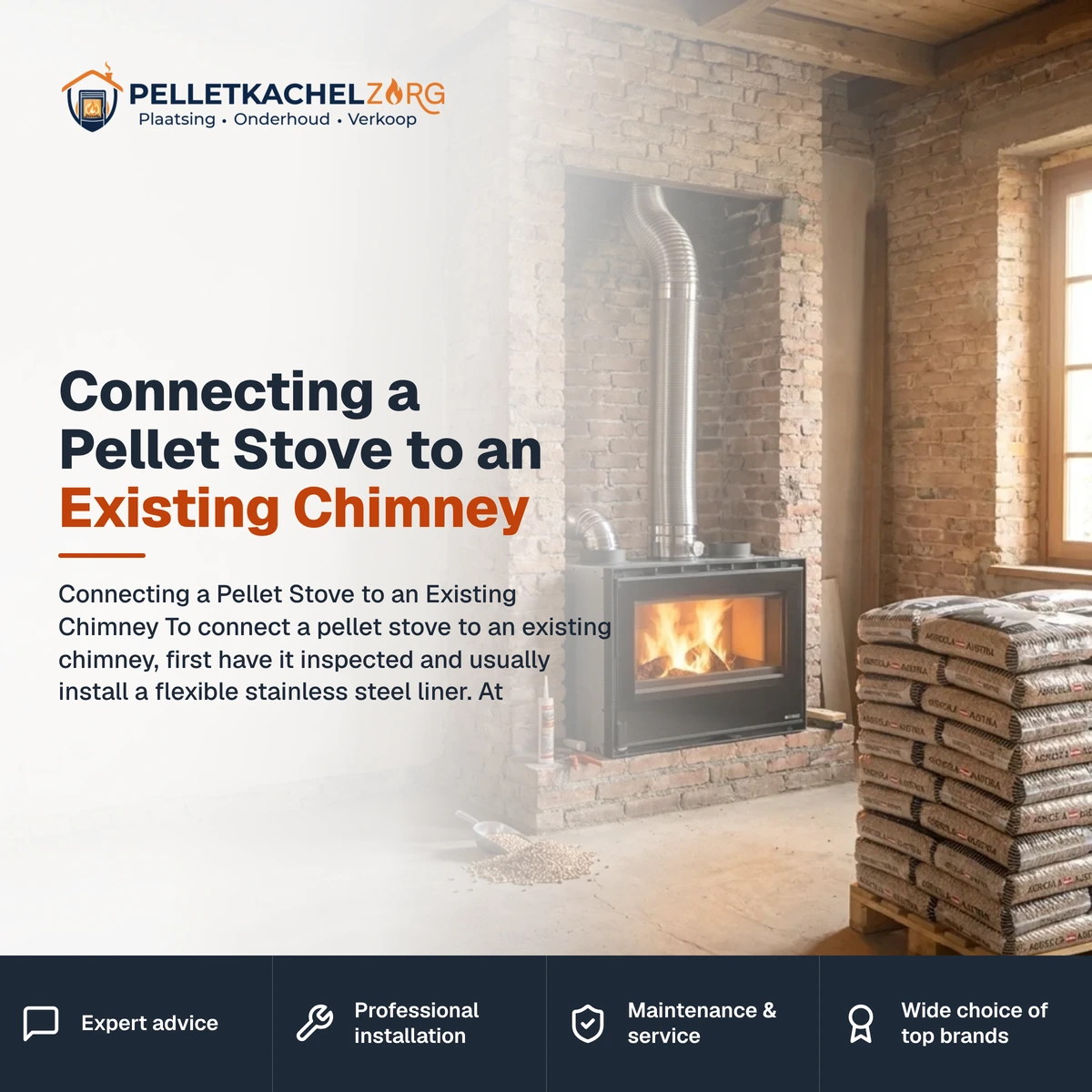
To connect a pellet stove to an existing chimney, first have it inspected and usually install a flexible stainless steel liner. At the bottom, a T-piece with a condensate trap is added, followed by a check of the draft and air supply.
An existing chimney can serve as a carrier, but almost always with a stainless steel liner and condensate collection.
You can connect a pellet stove to an existing chimney, provided it is first inspected and usually fitted with a flexible stainless steel liner. The existing chimney provides the height and route, while the diameter and density must match a pellet stove.
Pellet exhaust gases are cooler and more humid than those from a wood fire, making condensation a real concern. Therefore, most installations receive a stainless steel liner with condensate collection. Below, you'll find what you can reuse, what needs adjustment, and the steps involved.
A proper connection revolves around three things: the right diameter, a condensation-resistant liner, and sufficient draft. If any of these are missing, you risk smoke issues, moisture, or, in the worst case, carbon monoxide. Connecting a pellet stove to a chimney is always custom work.
An existing chimney can serve as a carrier, but is rarely suitable for a pellet stove without a stainless steel liner.
Pre-Inspection of Chimney
We check the tightness, condition, and diameter of your existing chimney. This ensures you know if a liner is needed before anything is installed.
Professional Connection
Our installations use the correct stainless steel liner, T-piece, and condensate trap. You get a connection suitable for the lower exhaust gas temperature of pellets.
Inspection and Certification
After the connection, we arrange the inspection and certification. This keeps your installation safe and compliant for your insurer.
The sequence below prioritizes safety and control. Each step builds on the previous one, so never skip the inspection to save time.
Have the chimney inspected for tightness, condition, and internal diameter, possibly with a camera inspection.
Determine the correct diameter for your stove and choose a flexible stainless steel liner that fits.
Install the stainless steel liner in the existing chimney, from the outlet to the connection opening at the bottom.
Mount a T-piece with a condensate trap at the bottom to drain moisture and soot.
Connect the stove to the liner and check the air supply in the room and the draft.
Have the installation inspected and request a certificate to ensure safety and insurance compliance.
Chimney inspected for cracks, tightness, and internal diameter
Stainless steel flexible liner with the correct diameter and condensation-resistant quality
T-piece with condensate trap at the bottom for moisture and soot drainage
Check of the draft and sufficient air supply in the room
Outlet and distance to the roof in compliance with standards
Inspection and certificate of the connection arranged
The diameter determines whether the exhaust gases are expelled smoothly. A chimney that is too wide slows down the exhaust gases and increases condensation, while a passage that is too narrow hinders the draft. The stainless steel liner adjusts the size to the value specified in your stove's manual.
In addition to the draft, the air supply is also important. A pellet stove needs fresh air to burn, especially in well-insulated and airtight homes. Often, a separate air supply from outside is the best choice.
After installation, always have the draft measured and the installation checked. This ensures that the connection works safely before you use the stove daily.
You can usually reuse the existing chimney as a structure, but the interior almost always requires adjustment. The shaft, height, and route remain, while the actual exhaust gas discharge runs through a new stainless steel liner.
What you can rarely reuse unchanged is an old, too wide, or damaged interior. A brick chimney that has served an open fireplace for years is usually too wide and not condensation-resistant for pellets. The exhaust gases then cool too quickly, and moisture settles on the walls.
A flexible flue in an existing chimney adjusts the diameter to the value your stove needs. To know when this is really necessary, read when a stainless steel flexible in an existing chimney is needed.
At the bottom, a T-piece with condensate trap is required, as the moisture released by pellets needs to be directed somewhere. If you're unsure about the setup, check which flue you need for a pellet stove.
In Belgium and the Netherlands, regulations are not identical, and even within a country, the approach varies by municipality. In Belgium, reference is often made to NBN standards for exhaust, while exact requirements can vary by region and municipality.
In the Netherlands, policies also differ by municipality, and insurers may require an inspection or periodic sweeping. Therefore, inquire in advance about the evidence you need to ensure coverage in case of damage.
Both your municipality, region, and insurer may impose conditions on the connection and inspection. Always consult your stove's manual as the binding source for diameter and draft.
Since connecting to an existing chimney is truly skilled work, it's worth knowing when you need a professional for your flue. Safety always takes precedence over speed or cost.
Want to be sure if your chimney is suitable and what the connection costs? Request a quote or advice without obligation.
We are happy to help. Contact us without obligation.
Not every chimney is suitable. It must be sealed and in good condition, and the internal diameter must fit your stove. In practice, a stainless steel liner is almost always needed for the correct size and condensation resistance.
Pellet exhaust gases are cooler and more humid than wood, causing condensation in a chimney that is too wide or not condensation-resistant. A stainless steel flexible liner adjusts the diameter to the correct value and safely drains moisture.
The T-piece forms the bottom connection, and the condensate trap collects moisture and soot. This keeps the liner dry and easy to empty and clean. Without condensate collection, moisture can enter the stove or chimney.
Technically, you can, but connecting to an existing chimney is skilled work where much can go wrong. Incorrect diameter, a leaky chimney, or insufficient draft are unsafe. Have the chimney inspected and the connection certified.