

Certified Systems
We work with flues that carry a valid CE designation and performance declaration. This ensures the flue is tested for temperature and corrosion.
Have a pellet stove installed with the utmost care? Get a quote in 5 steps.
Have a pellet stove installed with the utmost care? Get a quote in 5 steps.
Have a pellet stove installed with the utmost care? Get a quote in 5 steps.

 Written by Dries Nijs4 min read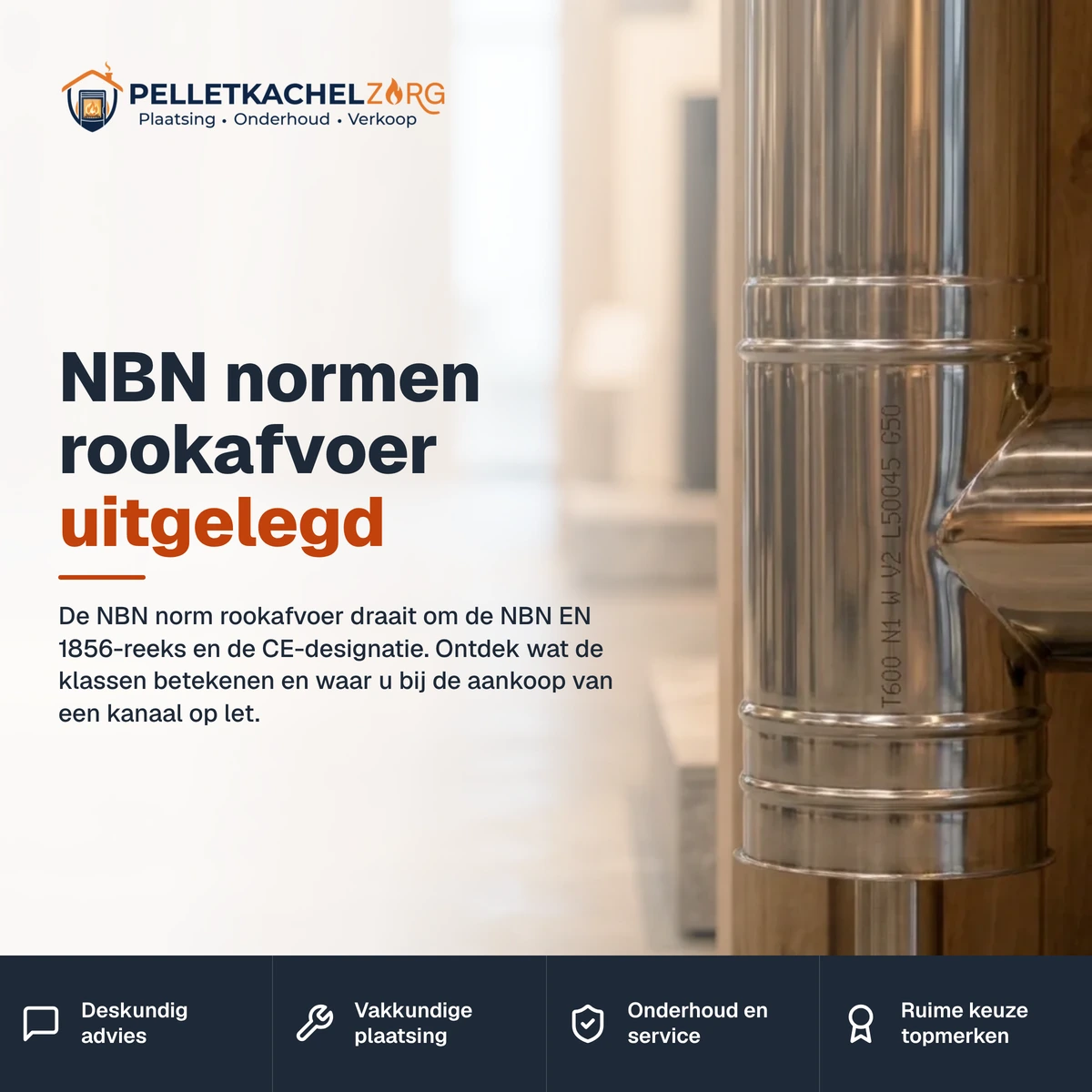
The NBN flue standard refers to the EN 1856 series, which tests and marks metal flues. The imprinted designation shows the temperature, pressure, corrosion, and soot fire class. This helps you check if a flue matches your stove.
Always choose a class that suits your appliance and fuel.
The NBN flue standard primarily refers to the European product standard NBN EN 1856, which specifies how a metal flue is tested and marked. These standards define the temperature, pressure, and corrosion a flue can safely handle. The manufacturer tests the system and imprints the results as a designation on the flue. This way, you can see if a flue matches your appliance and fuel.
The letters NBN and EN indicate the same European standard, with a Belgian designation in front. The EN 1856 series consists of multiple parts, including system chimneys and separate connectors. For you as a user, the most important thing is that a certified flue has a clear imprint.
A standard proves the product's quality, not the correctness of your installation.
Certified Systems
We work with flues that carry a valid CE designation and performance declaration. This ensures the flue is tested for temperature and corrosion.
Tailored Advice
We compare the flue's class with your stove and fuel. You get a setup that fits your situation and home.
Proper Installation
Our installers consider the distance to combustible materials and a clear outlet. This ensures your installation meets safety requirements.
The imprint looks like a code, but each part has a meaning. Usually, the temperature class, pressure class, and corrosion class are listed in sequence. Below, you'll find the main components explained in plain language.
Temperature Class (T). This number shows the maximum flue gas temperature the flue can handle, for example, a lower class for a pellet stove.
Pressure Class (N, P, or H). This letter indicates under what pressure the flue remains tight and leak-free.
Condensation and Moisture (W or D). The designation W stands for wet operation with condensation, D stands for dry operation.
Corrosion Class (V). This class links the material to the fuel, for example, a designation like V2 for certain applications.
Soot Fire Resistance (G or O). The letter G means resistant to a soot fire, O means not soot fire resistant.
Distance to Combustible Materials. The number after G or O shows the safe distance to wood or plaster. Learn more about the distance to combustible materials for stove pipes.
These components are usually in a fixed order on a label or on the flue's casing. If you don't recognize the code, ask the seller for the meaning or for the performance declaration. This way, you avoid a flue that doesn't match your stove on paper.
A complete system carries a coherent designation, as the standard tests the components as a whole. Combining separate pieces from different brands loses that certified coherence. Therefore, manufacturers recommend staying within an approved system, from the connection to the outlet on the roof.
The points below help you quickly review the imprint and the paperwork. It's best to compare them alongside your stove's manual so you don't overlook anything.
Request the CE certificate and performance declaration
Check if the designation is on each element
Compare the temperature and corrosion class with your stove's manual
See if the flue and appliance brands are compatible
Keep the documents for your insurance and maintenance
Always start with your stove's manual, as it specifies the required diameter and class. A pellet stove has different requirements than a wood stove, partly due to the lower flue gas temperature and the possibility of condensation. If you're unsure about single or double-walled, read the difference between single or double-walled flue.
If you want to know which setup suits your stove, the overview on which flue you need for a pellet stove can help. If in doubt, have a professional confirm the suitability.
Besides the class, the diameter and draft height also play a significant role. A flue that is too narrow or too short causes draft problems, even if it meets the standard. Your appliance's manual usually mentions a minimum height and a recommended diameter, and these figures are as important as the class itself.
The NBN EN 1856 series is a European standard, so the same CE designation applies in Belgium and the Netherlands. However, installation rules differ by region and municipality. In Belgium, local regulations play a role alongside the product standard, see the explanation on flue regulations in Belgium.
In the Netherlands, the name NBN is not used, but the CE designation on the flue remains identical. National building regulations and local rules supplement the product requirements. For a current overview, consult the flue rules in Belgium for 2026. Always check with your municipality and insurer as binding sources.
The standard and the imprint are a good starting point, but not a complete answer on their own. They show what the product can handle, while the setup, penetrations, and distances in your home determine the rest. A correct choice combines the right class with an installation that meets local regulations.
Not sure if your flue meets the right class? Request a quote or advice and have your flue's suitability checked.
We are happy to help. Contact us without obligation.
The NBN flue standard, especially the EN 1856 series, specifies how a metal flue is tested and marked. The standard sets the temperature, pressure, corrosion, and soot fire class. It shows if a flue is safe and suitable.
You usually find the designation on a label or on the flue's casing. The seller also provides a performance declaration and a CE certificate. Keep these documents for your maintenance and insurance.
Yes, because the EN 1856 series is a European standard with the same CE designation in Belgium and the Netherlands. The name NBN is not used in the Netherlands. Installation rules do vary by municipality.
No, the standard proves the product's quality, but not that it suits your stove. Always compare the class with your appliance's manual. If in doubt, have a professional confirm the suitability.


