
Recognized expertise
Our installers know the requirements for pellet appliances in detail. You get a flue that draws safely and meets the standard.
Have a pellet stove installed with the utmost care? Get a quote in 5 steps.
Have a pellet stove installed with the utmost care? Get a quote in 5 steps.
Have a pellet stove installed with the utmost care? Get a quote in 5 steps.

 Written by Dries Nijs4 min read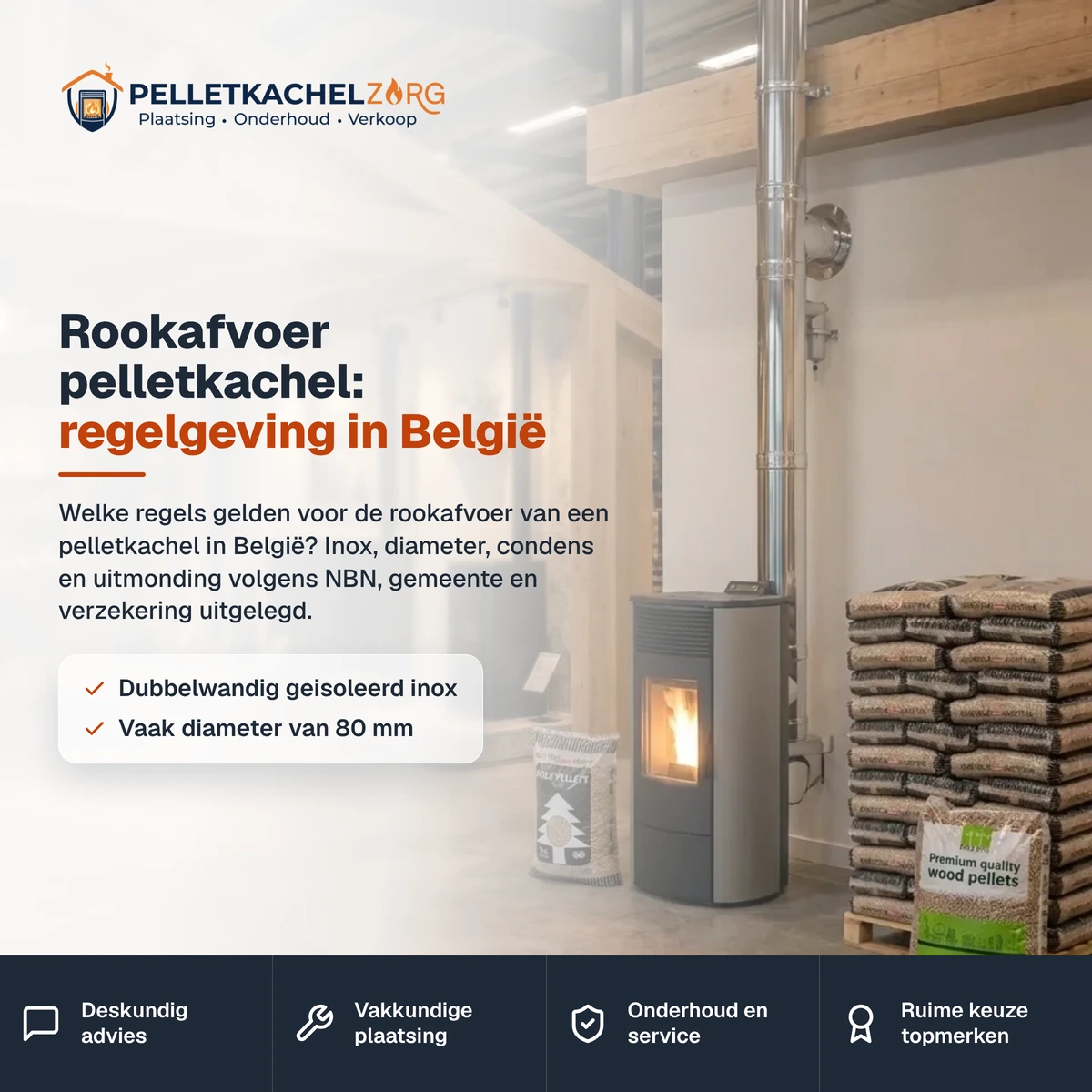
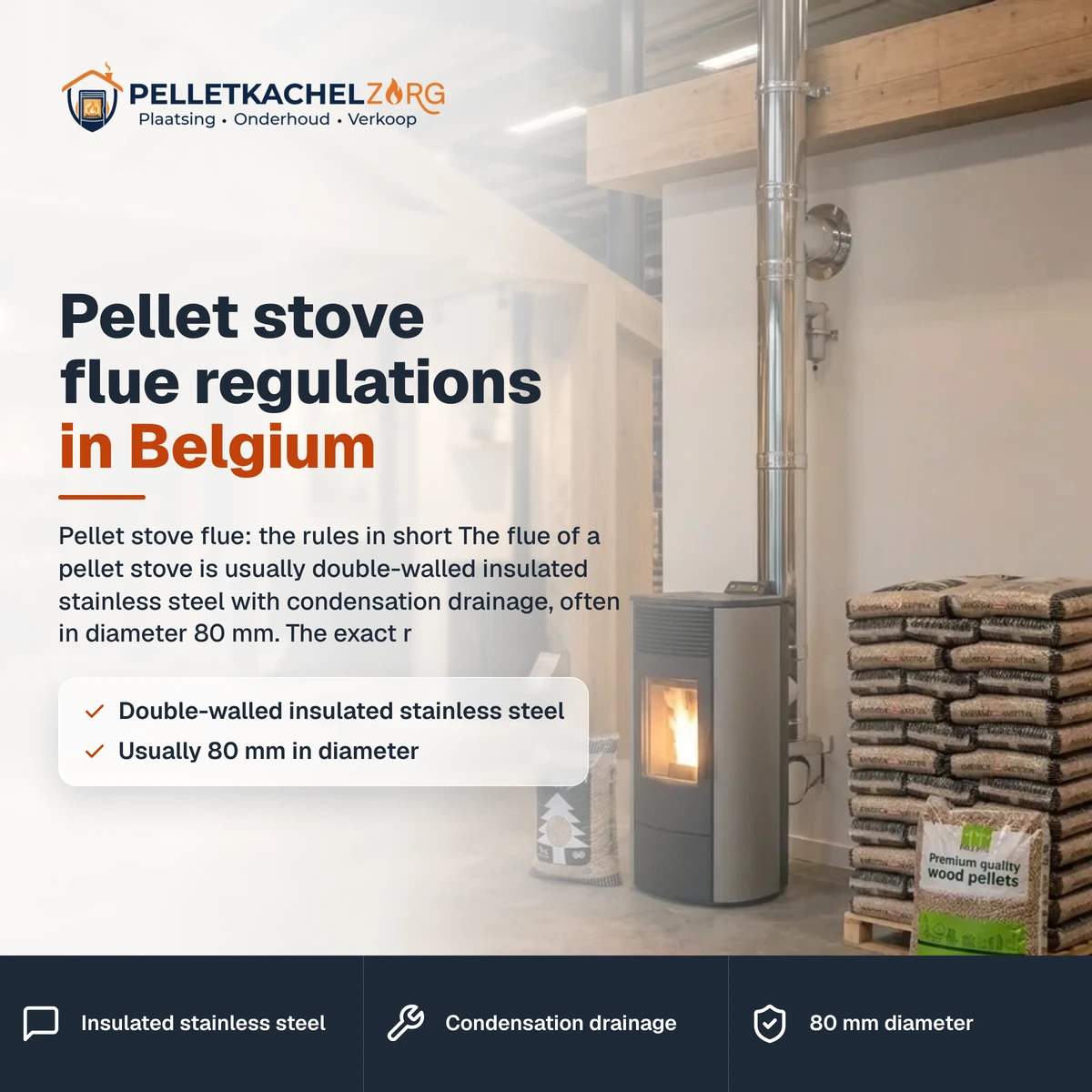
The flue of a pellet stove is usually double-walled insulated stainless steel with condensation drainage, often in diameter 80 mm. The exact rules follow from the manual, the NBN standards, your municipality or region and your insurer.
Follow the manual and check with your municipality before you determine the outlet.
The rules for the flue of a pellet stove differ from those for a wood stove, because the flue gases are cooler and more humid. In Belgium, no single national law dictates everything. You combine the manufacturer's manual, the NBN standards, the requirements of your municipality or region and the conditions of your fire insurance. In practice, this means double-walled insulated stainless steel with condensation drainage and a correct outlet.
The flue of a pellet stove has two sides. On the one hand, there are the technical requirements that determine safe operation. On the other hand, there are the administrative obligations imposed by your municipality, region and insurer. Both must be right, because a technically perfect drain that ignores local rules will still cause problems.
Always follow the manual of your stove first, because it determines the minimum requirements on which insurance and installer fall back.
Recognized expertise
Our installers know the requirements for pellet appliances in detail. You get a flue that draws safely and meets the standard.
According to NBN and manual
We match material, diameter and condensation drainage to your appliance. The installation follows the NBN standards and the manufacturer's instructions.
Tailor-made advice
Every home and chimney is different, so we view your situation on site. You know beforehand what is allowed and what your insurer expects.
The following points come up in almost every project. They translate the official standards into practical choices on site.
Material: choose double-wall insulated stainless steel, so the flue gases stay warm enough and the draft remains stable.
Diameter: follow the manual, as pellet stoves often work with 80 mm and sometimes 100 mm for longer flues.
Condensation: place a T-piece with a condensation cap at the bottom, ensuring moisture is drained and does not run into the stove.
Draft: ensure sufficient vertical height, because too little height causes poor draft and backdrafts of smoke.
Terminal: respect the clearance distances to the roof surface, windows, and neighbors imposed by your municipality or region.
Connection: connect to a suitable chimney, never just to an overly spacious old chimney without a stainless steel liner.
If your situation deviates, such as an existing chimney or a long horizontal connection, have the draft calculated in advance to see if it is sufficient.
Most problems arise from the wrong combination of these elements. A diameter that is too large cools the flue gases, which weakens the draft and causes more condensation. A terminal that is too low causes backdrafts during windy weather. Therefore, treat these points as a whole, not separately.
Go through these points before using the stove. If one is missing, that is the first thing you should have checked.
Read the manual and noted the prescribed diameter
Provided double-wall insulated stainless steel from the connection point
Condensation collector with T-piece and cap at the lowest point
Terminal regulations checked with your municipality or region
Fire insurance and manual aligned
Cleaning and certificate by a recognized professional scheduled
A wood stove produces much hotter flue gases and often works with a larger diameter and a single-wall pipe inside the room. A pellet stove requires the exact opposite: insulation against cooling and strict condensation drainage. That difference explains why you cannot simply reuse a wood stove flue for a pellet stove.
The draft also works differently. A pellet stove mechanically pushes the flue gases outside with a flue gas fan, but it remains dependent on a healthy chimney. If the power fails, there must still be enough natural draft to safely extract the smoke. A correct height and proper insulation remain indispensable, even with a forced exhaust.
The technical choices are not just minor details, as they stem directly from regulations and safety standards. If you want to know which setup suits your appliance, first read which flue a pellet stove needs. This way, you immediately choose the right material and the correct diameter.
The condensation issue is specific to pellet appliances. Due to the lower flue gas temperature, moisture is created and must be collected at the bottom. In why condensation collection is important for pellet stoves, you can read how a T-piece with a cap solves this. If you are unsure about single or double-wall, check out when a double-wall flue is necessary.
Flue gas extraction in Belgium falls under various jurisdictions, so there is no uniform rule for the entire country. Flanders, Wallonia, and Brussels each have their own emphasis, and municipalities sometimes add extra requirements regarding the terminal. Therefore, always consult your local council before finalizing the exit location.
For the broader context, the broader regulations for flues in Belgium can help. The technical foundation can be found in how the NBN standards for flue extraction work. In the Netherlands, rules also vary by municipality, with the manual and local regulations remaining the guiding principles.
Your fire insurance also plays a role. In the event of damage, the insurer may ask whether the installation was done according to the rules and the manual, and whether the chimney was maintained. A cleaning certificate from a recognized professional and correct installation are your best proof. When in doubt, have the connection inspected.
If you are unsure whether your flue meets the requirements, have it checked before you start firing. Request a free quote or advice and you will immediately know where you stand.
We are happy to help. Contact us without obligation.
Usually 80 mm, but the manual of your stove is binding. For long or high channels, the manufacturer sometimes prescribes 100 mm. Never just choose a larger size, because that disrupts the draft.
In most cases yes, because double-walled insulated stainless steel keeps the flue gases warm and limits condensation. Single-walled is only allowed on short inner parts. The manual and local practice determine what is permitted.
Condensation drainage is technically necessary, because the cooler flue gases of a pellet stove release moisture. You place a T-piece with condensation cap at the bottom. Without this catch, moisture runs back into the appliance and affects your stove.
In principle you may, but your insurer and municipality set conditions for correct, safe execution. In the event of damage, incorrect installation can cost your coverage. Therefore, if in doubt, have the connection inspected by a recognized professional.