

Certificate with every sweep
After every cleaning, you will receive a dated document with the findings. This gives you tangible proof for your insurance or rental contract.
Have a pellet stove installed with the utmost care? Get a quote in 5 steps.
Have a pellet stove installed with the utmost care? Get a quote in 5 steps.
Have a pellet stove installed with the utmost care? Get a quote in 5 steps.

 Written by Dries Nijs3 min read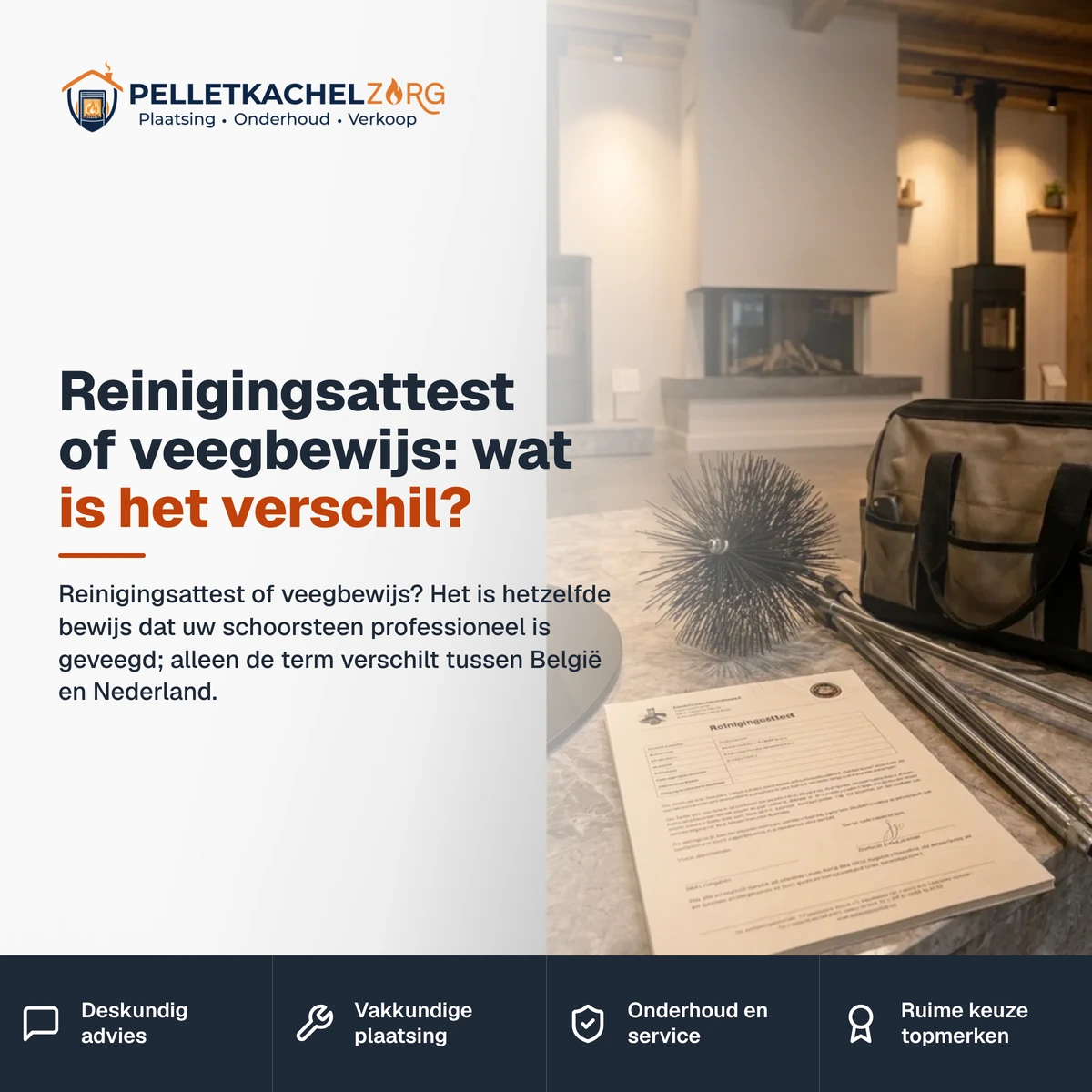
A cleaning certificate or sweeping certificate refers to the exact same document: proof that your chimney or flue was professionally swept and inspected. The difference lies in the terminology and region, not the actual function.
In Belgium, it is usually called a cleaning certificate, whereas in the Netherlands it is known as a sweeping certificate. You will need it for your fire insurance, your rental agreement, or when selling your home.
In practice, a cleaning certificate and a sweeping certificate refer to the same type of document: the written proof that a professional has cleaned and checked your chimney or flue. The difference is mostly in the name and the location, not in its purpose. In Belgium, people generally speak of a cleaning certificate, while the Netherlands mostly uses the term sweeping certificate. Such a document states who performed the cleaning, when it happened, which appliance was serviced, and the findings. You mainly need it for your fire insurance, your lease agreement, or when selling your property.
It is understandable that the two terms cause confusion, as you will encounter both as soon as you look up anything related to chimney maintenance. The reason is simple: it is just regional terminology for the same underlying proof. A chimney sweep in Flanders often calls the paperwork they leave behind a cleaning certificate, while a colleague just across the border calls it a sweeping certificate. In both cases, the document confirms that a professional has cleaned the flue, checked the draft, and assessed the safety. The comparison below highlights the main similarities and subtle differences.
The similarities heavily outweigh the differences. Both documents link a specific date to a specific home and appliance, and both state whether the sweep noticed anything unusual. The subtle difference is in the context: in Belgium, the recognition or enterprise number of the sweep often plays a role for the insurer, while in the Netherlands, the emphasis is more on the policy conditions. So do not let the name confuse you, but rather look at the contents of the paper you receive.
Remember the rule of thumb: the name varies by region, but the function remains the same, namely proving that your flue has been professionally swept and deemed safe.
Certificate with every sweep
After every cleaning, you will receive a dated document with the findings. This gives you tangible proof for your insurance or rental contract.
Professional inspection
We thoroughly sweep and inspect your chimney or flue. Any defects are honestly noted on the certificate.
Clear findings
You see exactly what was checked and if everything is deemed safe in writing. No vague terms, just concrete observations.
A useful cleaning or sweeping certificate is more than just a loose signature with a price. It must clearly show, even years later, exactly what was done. Therefore, check the following details upon receipt, because these specific points turn a simple note into a valid piece of evidence.
The date the cleaning and inspection were carried out.
The address of the property and the location of the cleaned flue.
The type of appliance, for example, a pellet stove, wood stove, or open fireplace.
The name and, where applicable, the certification or enterprise number of the sweep.
The findings: was the flue heavily soiled, were any defects found, or is everything in order?
In daily life, you rarely think about such a document until the moment someone suddenly asks for it. Usually, this happens at an inconvenient time, for instance right after a damage claim or during the sale of your home. The situations below occur most frequently.
Your fire insurance company requests proof of regular maintenance, especially after damage or a fire.
You are renting out a property and want to prove that maintenance is done annually.
You are selling your home and the buyer or notary asks about the chimney maintenance.
You want to keep your own record of when the flue was last swept.
Keep your cleaning or sweeping certificate safe, as it will be your only tangible proof later on that the maintenance was done correctly and on time. A dated document shows that you, as a resident or owner, have fulfilled your duty of care, which really counts if something goes wrong. If you want to know exactly what this document entails, you can read our overview on what a cleaning certificate is. For pellet appliances, we explain in a separate article why a cleaning certificate for a pellet stove is often mandatory, so you know what your insurer and manufacturer expect.
A handy system is to keep all certificates together with your purchase invoice and the appliance manual in one place, either digitally or on paper. This way, you can easily locate the proof when an insurer, buyer, or tenant asks for it, and you can show at a glance that maintenance was performed year after year. A series of consecutive certificates is also much more convincing than a single loose document, as it shows a consistent maintenance pattern.
The exact name and requirements depend on your region and municipality in Belgium, and your municipality in the Netherlands, so there is no single national standard rule that applies everywhere in the same way. In Flanders, periodic sweeping is recommended or even made mandatory in many places through municipal regulations, whereas in the Netherlands you are mostly bound by your municipality and your insurance policy. Therefore, specifically check if chimney sweeping is mandatory in Belgium and what the rules are in the Netherlands, and also check what your insurance requires for stove maintenance. The binding source is always your municipality, your region, your insurer, or the manual of your appliance.
Are you unsure whether your chimney or flue is due for a sweep, or do you want to get a proper certificate right away? Request a free quote or advice and together we will look at what is needed for your appliance and situation.
We are happy to help. Contact us without obligation.
Yes, in practice both terms refer to the same document: proof that your chimney or flue was professionally swept and inspected. In Belgium, it is generally called a cleaning certificate, while the Netherlands more often uses the term sweeping certificate. The function and core details are always the same.
It should at least include the date of the cleaning, the address, the type of appliance, and the name of the sweep who performed the service. Additionally, a good certificate states the findings during the inspection, such as the degree of fouling or any identified defects. This makes it clear what was done.
You mostly need it for your fire insurance, your lease agreement, and when selling your home. The insurance company wants to verify whether regular maintenance took place, especially after damage or a fire. Therefore, keep the document with your home paperwork.
A professional who actually cleans and inspects the chimney or flue issues the certificate. In some municipalities or regions, a certified chimney sweep is required. Ask beforehand what your municipality and insurer specifically demand.


