
According to NBN standards
We work with CE-marked materials according to the NBN EN 1856 series. This ensures your flue is technically compliant and safe.
Have a pellet stove installed with the utmost care? Get a quote in 5 steps.
Have a pellet stove installed with the utmost care? Get a quote in 5 steps.
Have a pellet stove installed with the utmost care? Get a quote in 5 steps.

 Written by Dries Nijs4 min read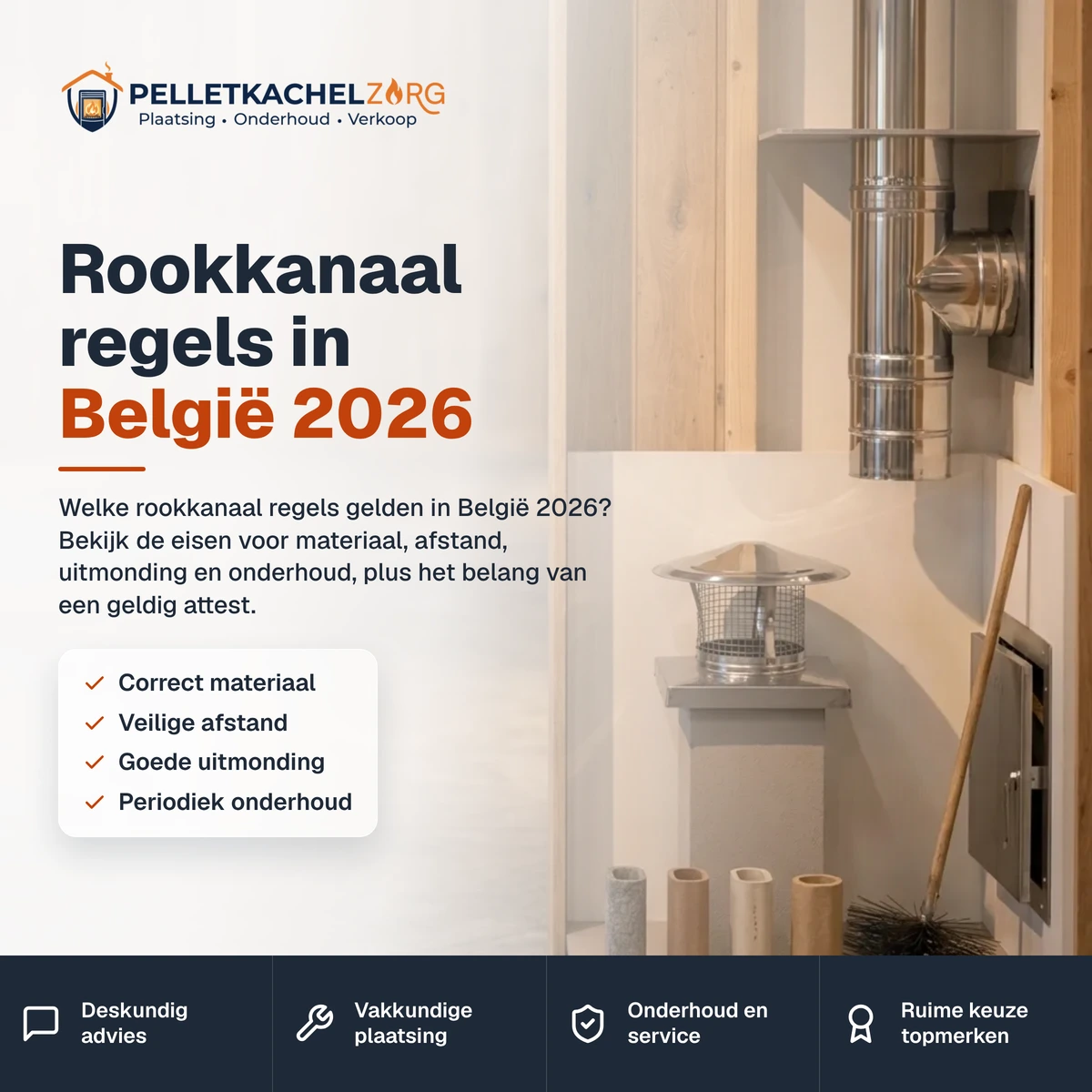
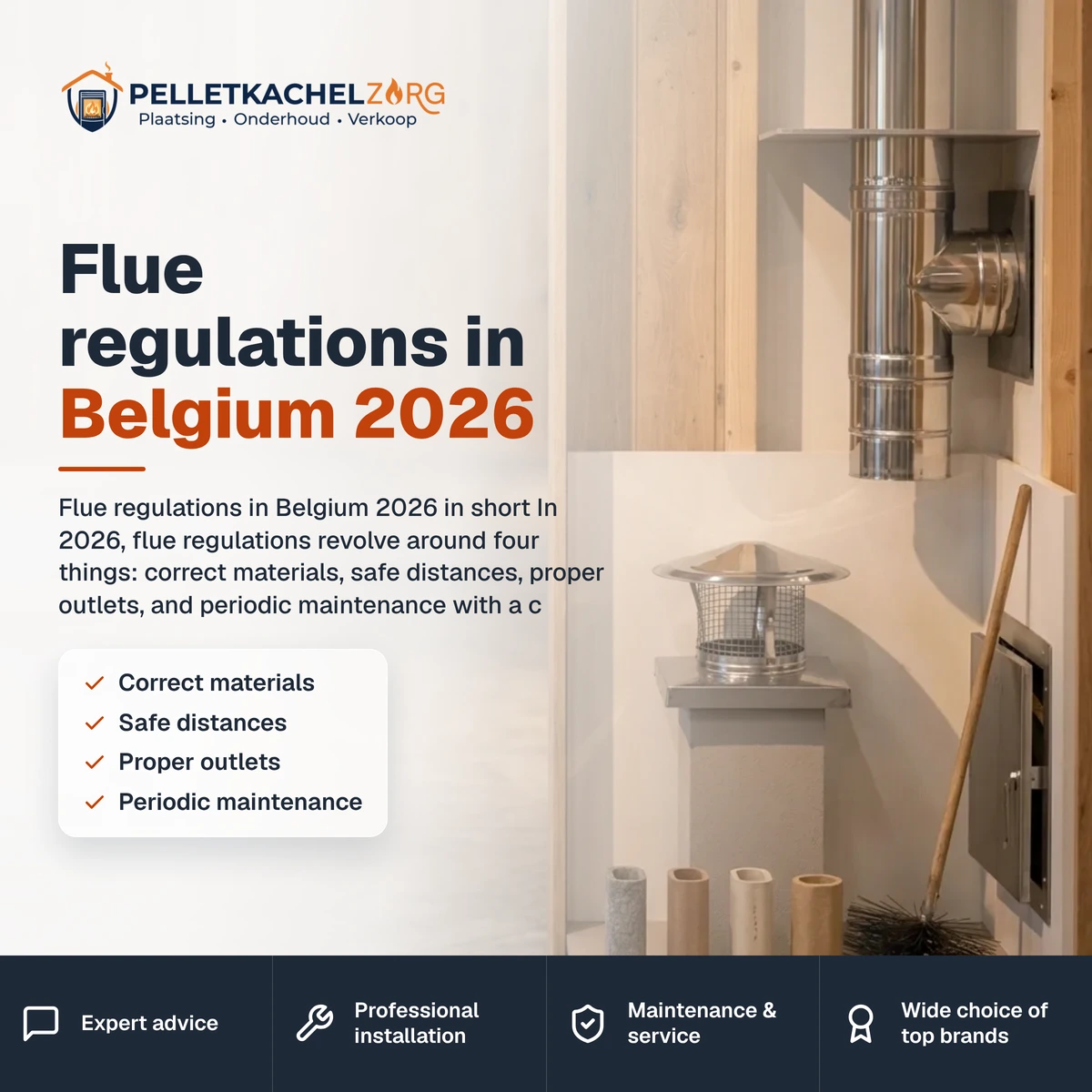
In 2026, flue regulations revolve around four things: correct materials, safe distances, proper outlets, and periodic maintenance with a certificate. There is no new federal law; the foundation remains the NBN standards, while the region and municipality fill in the details.
Technology follows the standard,
maintenance and certificates follow your region and insurer.
The flue regulations in Belgium 2026 revolve around four fixed pillars: correct and CE-marked materials, sufficient distance to combustible materials, a proper outlet, and periodic maintenance with a certificate. There is no new federal law that suddenly overturns this framework in 2026.
Most things remain regulated via the NBN standards, the regions, and your municipality. What applies in 2026 is therefore mainly a stable set of technical standards and local obligations. The specific details vary by region and municipality, so always check this with your municipality or a recognized professional before you start.
Remember a rule of thumb: the technology follows the NBN standards and the manufacturer, while maintenance and certificates are determined by your region and insurer.
According to NBN standards
We work with CE-marked materials according to the NBN EN 1856 series. This ensures your flue is technically compliant and safe.
Certificate for your insurance
You will receive a clear cleaning or conformity certificate. This serves as your proof for the fire insurance.
Advice tailored to your municipality
We take the rules of your region and municipality into account. This helps you avoid problems with the outlet.
The core rules below summarize what counts in 2026 for a safe and compliant flue. They serve as a practical guide; you can read the exact details at your municipality and in the manual of your stove, because that is exactly where the binding dimensions and conditions are found.
Only use materials with CE marking according to the NBN EN 1856 series, tailored to your type of stove and fuel.
Respect the minimum distance to wood, plasterboard, and other combustible materials, according to the manufacturer and the standard.
Ensure the outlet is high enough and at a sufficient distance from skylights, dormer windows, and neighboring homes.
Choose the correct diameter and limit the number of bends, so that the draft and discharge remain reliable.
Have the flue cleaned periodically and keep the certificate, as this is your proof for the fire insurance.
Check the local rules of your municipality, because urban planning and outlet regulations can be stricter locally.
Does each part have a CE marking and does the class match your stove
Does the distance to beams, walls, and roof boarding match the manual
Does the outlet protrude far enough above the roof edge and away from windows
Do you have a recent cleaning or sweeping certificate in your name
Do you know the cleaning frequency imposed by your region
Does your fire insurer set additional conditions for maintenance
A valid cleaning certificate is your most important piece of evidence after a chimney fire. Insurers often link their intervention to periodic and demonstrable maintenance, so keep every sweeping certificate neatly filed. Exactly how often sweeping is required varies by region, which you can read in our overview on whether chimney sweeping is mandatory in Belgium.
Besides maintenance, the installation itself also counts. A conformity certificate upon installation shows that the flue was executed according to the standard. For the full legal background, read our explanation of the flue regulations in Belgium.
Also pay attention to the relationship between the certificate and your policy. Some insurers require cleaning by a recognized professional, while others also accept self-maintenance, provided you can record and prove it. Ask about this in advance so you don't face any surprises in the event of damage.
The broad outlines are the same throughout Belgium, but the details differ by region and municipality. Flanders, Wallonia, and Brussels each have their own emphases for cleaning and supervision, and municipalities sometimes impose extra requirements for the outlet. The technical basis, however, remains the NBN series of standards everywhere, which you can find in our explanation of the NBN standards for smoke discharge.
If you work with a pellet stove, specific points of attention apply regarding condensation and materials. We list these separately in our article on flue gas discharge and regulations for a pellet stove in Belgium. For a broader perspective, you can also read the general rules for flues in Belgium, so you understand the full framework before making a choice.
A common misunderstanding is that the year 2026 itself introduces new obligations. In practice, it involves the same stable framework, which municipalities and regions are gradually refining. More important than the year is that your installation is technically correct and that your maintenance is demonstrably in order.
A quick check beforehand often prevents expensive repairs afterwards. A professional can immediately see whether the material, the distance, and the outlet comply with the standard and the requirements of your municipality.
If you are unsure whether your flue is fully compliant in 2026, have it checked by a professional before you proceed. Request a non-binding quote or advice and you will immediately know where you stand.
We are happy to help. Contact us without obligation.
In 2026, the existing NBN standards mainly apply, supplemented by regional maintenance rules and local municipal guidelines. There is no new federal law completely changing things. Always check the details with your municipality or a professional.
A conformity certificate is highly recommended and in practice required by many insurers. It proves that the installation was done according to the standard. Without it, you risk disputes after a damage claim.
The outlet must protrude high enough above the roof edge and stay clear of skylights and neighbors. The exact measurement depends on the standard, roof type, and sometimes your municipality. A professional can calculate this correctly for you.
Yes, the main principles are the same, but cleaning, supervision, and local outlet requirements differ by region and municipality. Flanders, Wallonia, and Brussels each have their own specifics. Therefore, always check your local municipality's rules.