
Advice Tailored to Your Situation
We assess the entire trajectory of your flue. This way, you immediately know where single-wall suffices and where double-wall is necessary.
Have a pellet stove installed with the utmost care? Get a quote in 5 steps.
Have a pellet stove installed with the utmost care? Get a quote in 5 steps.
Have a pellet stove installed with the utmost care? Get a quote in 5 steps.

 Written by Dries Nijs3 min read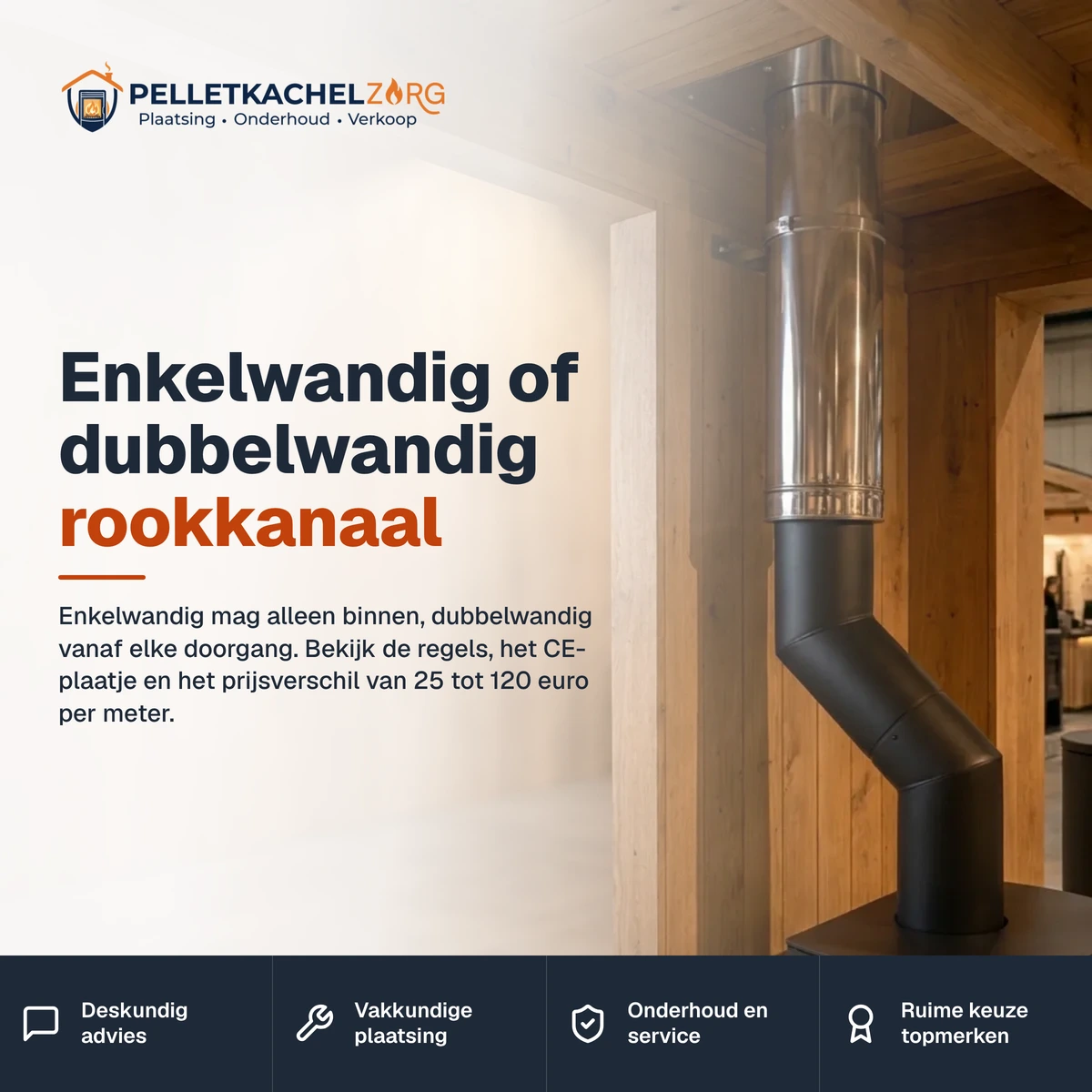
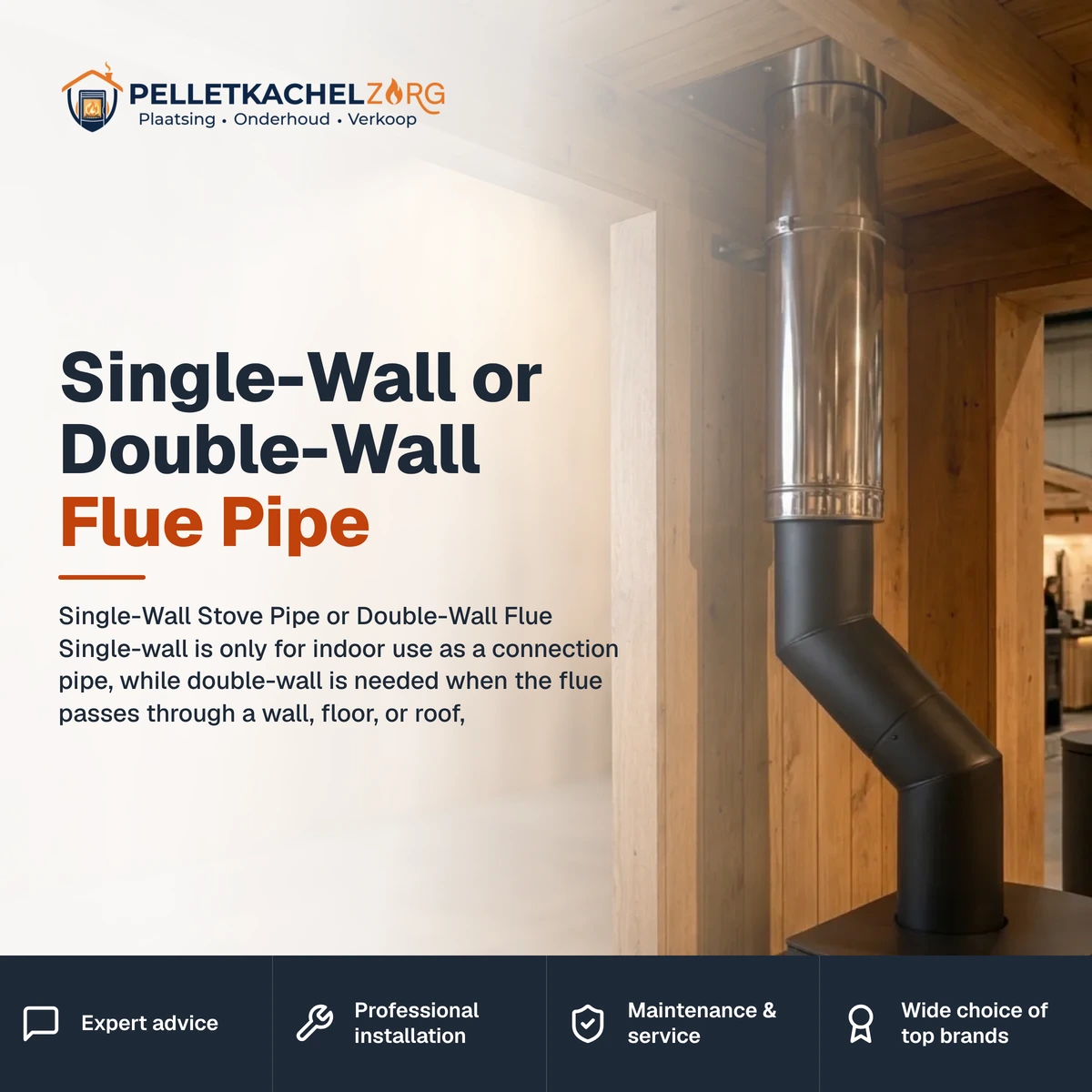
Single-wall is only for indoor use as a connection pipe, while double-wall is needed when the flue passes through a wall, floor, or roof, or runs outside. The price difference is 25 to 45 euros compared to 80 to 120 euros per meter, but saving in the wrong place can cost more.
Indoors, single-wall is allowed, but from the first passage, it must be double-wall.
Use single-wall only indoors, in the room where the stove is located, and switch to double-wall when the flue passes through a wall, floor, or roof, or runs outside. The price difference is significant: 25 to 45 euros per meter compared to 80 to 120 euros per meter. However, saving in the wrong place is the most expensive mistake here.
Below, you'll see the differences, learn how to read the CE marking, and we calculate the price difference for you.
Both types expel flue gases, but they do so at different points in the trajectory.
Inside the living space, single-wall is allowed, but from the first wall, floor, or outside air, it becomes double-wall.
Advice Tailored to Your Situation
We assess the entire trajectory of your flue. This way, you immediately know where single-wall suffices and where double-wall is necessary.
According to Standards
We install according to current installation rules and NBN standards. The CE marking and your appliance's manual always remain leading.
Safe Pass-Throughs
We execute pass-throughs through walls or roofs with insulated material. This ensures the distance to combustible parts is always correct.
Each flue carries a type plate, which specifies what is allowed. Three things matter for wood and pellets.
The temperature class: choose T400 or higher for solid fuels. The G-marking: it indicates that the flue can withstand a chimney fire, and the number following it shows the minimum distance to combustible materials in millimeters, G50 means 50 millimeters. And the diameter: always maintain the size of the appliance, 80 millimeters for pellets and 150 to 180 millimeters for wood. More background on standards can be found on Buildwise's standards page.
Start with a short single-wall connection pipe, as straight as possible and with a maximum of 2 bends.
Place the transition piece from single-wall to double-wall well before the first passage.
Pass through floors and walls with a fire separation and 50 to 80 millimeters of free space.
Continue fully double-wall outside or through unheated spaces.
Terminate according to height regulations, as described in the flue through the roof.
Never use single-wall outside or through a cold attic: the flue gases cool significantly, resulting in tar and draft loss.
Never reduce the diameter of the appliance, not even with a reducer of one size.
Do not mix parts from two brands, as the click and clamp systems will not seal gas-tight.
Do not skip the G-marking for wood and pellets, a chimney fire can reach 1,000 degrees or more.
Respect the 3 times diameter rule for single-wall, or install a heat shield.
What other parts you need can be found in the overview of all flue parts. The classic mistakes are listed in common mistakes with flues and the distance rules in the distance rules to combustible materials.
Component
Guide Price
Single-Wall Stove Pipe
25 to 45 euros per meter
Double-Wall Insulated Flue
80 to 120 euros per meter
Transition Piece Single-Wall to Double-Wall
40 to 70 euros
Bends and T-Pieces
30 to 90 euros each
A 5-meter trajectory costs approximately 175 euros for single-wall and about 500 euros for double-wall. This additional cost of over 300 euros is your insurance against condensation, tar, and poor draft, and in most parts of the trajectory, it is simply the only allowed choice.
The lifespan also differs: a single-wall steel pipe lasts 10 to 15 years, while a stainless steel double-wall system lasts 25 to 30 years. Many manufacturers offer a 10-year warranty on the latter, so keep the invoice and type plate.
The complete cost of a full flue can be read in what a completely new flue costs. The right pipes and transition pieces can be found in our webshop, or let our team install the entire flue.
Unsure which type is needed where in your trajectory? Request a free quote or advice and receive a plan with the correct setup and a fixed price.
We are happy to help. Contact us without obligation.
No, through walls, floors, and roofs you must use double-wall with 50 to 80 millimeters of free space or a certified pass-through. A single-wall pipe gets too hot for the surrounding structure and requires 3 times the diameter in free space.
Double-wall consists of 2 pipes with 25 to 30 millimeters of insulation in between, allowing the flue to keep flue gases warm and be placed close to combustible materials. Single-wall is a single steel pipe costing 25 to 45 euros per meter that emits heat to the room.
Inside the installation room, a single-wall pipe of 80 millimeters can be used as a connection pipe. From the first wall, floor, or outside air, a pellet stove also switches to double-wall, usually in the same inner diameter of 80 millimeters.
For passages and outdoors, yes, it is even the only correct choice. Inside the living space, a single-wall pipe provides useful heat to the room. Choose single-wall with 3 times the diameter distance, or a heat shield.
The G indicates that the flue can withstand a chimney fire of 1,000 degrees, and the number shows the minimum distance to combustible materials in millimeters. G50 means 50 millimeters. For wood and pellets, always choose a flue with G-marking and class T400 or higher.