

Certified Chimney Sweeps
Your chimney is swept by qualified professionals. You receive a correct sweeping certificate to present to the municipality and insurance.
Have a pellet stove installed with the utmost care? Get a quote in 5 steps.
Have a pellet stove installed with the utmost care? Get a quote in 5 steps.
Have a pellet stove installed with the utmost care? Get a quote in 5 steps.

 Written by Dries Nijs4 min read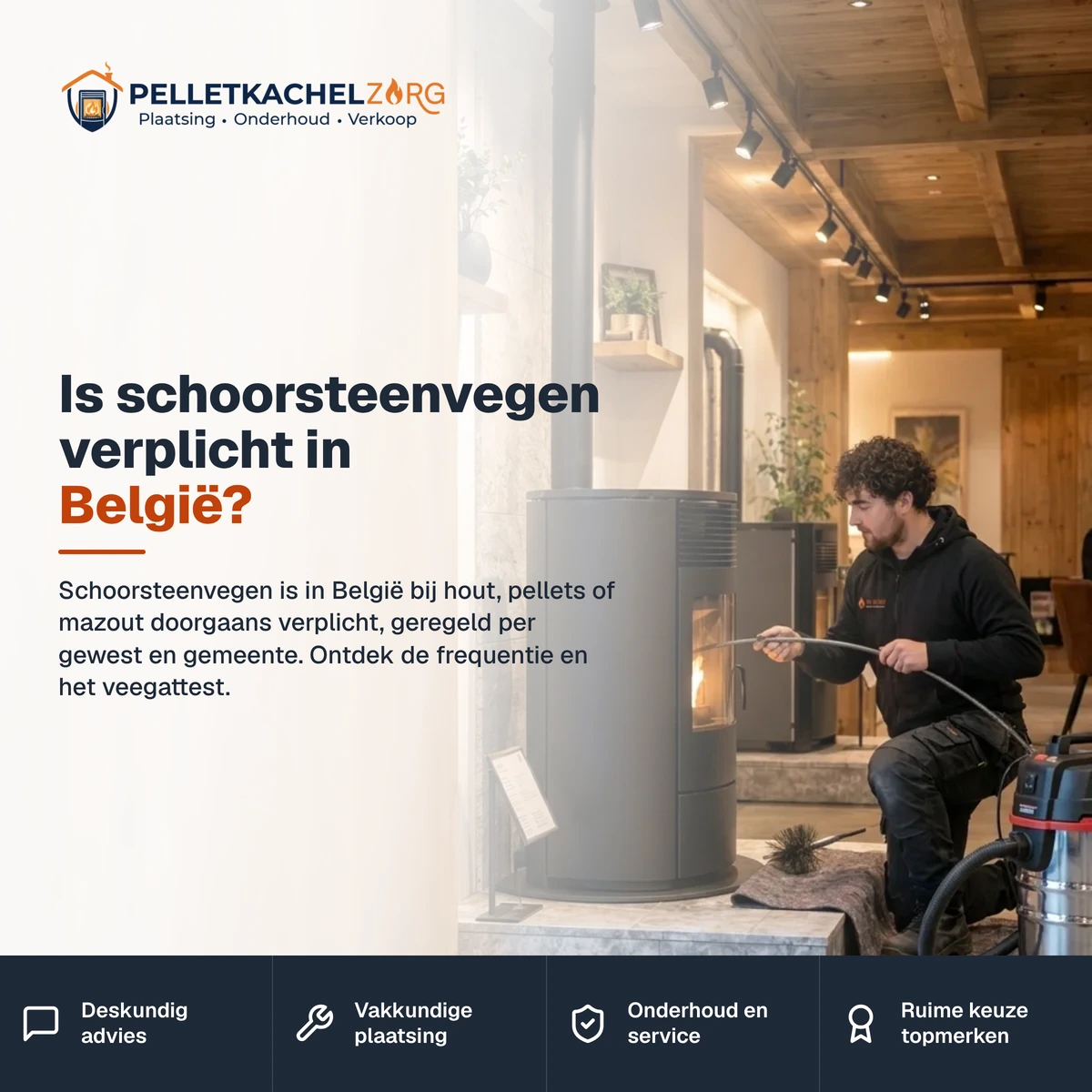
Yes, chimney sweeping is generally required in Belgium for wood, pellets, or oil. The rules are determined by region and, in Flanders, by municipality, usually at least once a year.
A valid sweeping certificate is your proof for the municipality and insurance, so always check your local regulations and policy terms.
Yes, in Belgium, chimney sweeping for appliances using solid or liquid fuel, such as a wood stove, pellet stove, or oil boiler, is generally mandatory. The rules are not federally determined but are set by region, and in Flanders, further specified by your municipality through a police ordinance or fire prevention regulation. In practice, this means a chimney in use must be swept at least once a year, with a valid sweeping certificate as proof. The exact frequency and wording differ per municipality and fuel type, so the question of whether chimney sweeping is mandatory always has a local answer in Belgium. For gas appliances, different, usually more lenient rules apply, as gas leaves much less soot and creosote. Besides the legal aspect, your insurance also plays a role, as it may require proof of maintenance.
Rule of thumb: have your chimney swept at least once a year by a certified chimney sweep and keep the certificate, both for legal and insurance purposes.
Certified Chimney Sweeps
Your chimney is swept by qualified professionals. You receive a correct sweeping certificate to present to the municipality and insurance.
Valid Sweeping Certificate
After each session, you receive a dated cleaning certificate with all findings. This ensures compliance with local rules and policy terms.
Region Limburg and Flemish Brabant
We know the municipal regulations in our region. You receive advice that aligns with the rules applicable to you.
Wood and wood briquettes: generally at least once a year, and often twice a year if used intensively as the main heating source, because wood deposits the most soot and creosote in the flue. Creosote is also the main cause of chimney fires.
Pellets: usually once a year. A pellet stove burns cleaner and more consistently than a wood stove but still deposits ash and fine soot particles in the flue, especially during long heating seasons.
Oil: generally once a year, often combined with the mandatory maintenance of the oil boiler imposed by your region, for which you receive a separate inspection.
Gas: in many municipalities, the sweeping requirement is more lenient, but periodic maintenance and inspection of the appliance and flue gas exhaust are still recommended or required.
The requirement is not to inconvenience you but to prevent fires and carbon monoxide poisoning. When burning wood, pellets, or oil, soot and creosote deposit on the flue walls, and this residue is flammable. A dirty or narrowed flue also draws less effectively, causing combustion gases to not exit smoothly and potentially allowing carbon monoxide into the home. By having it swept at least once a year, you keep the passage clear, the sweep checks the chimney's condition, and you reduce the risk of an expensive damage claim. The sweeping requirement and your safety go hand in hand.
You burn wood, pellets, or oil and haven't had it swept this heating season.
You don't have a valid sweeping certificate from the past year.
You notice poor draft, soot smell, or more smoke than usual in the living area.
You have an old or newly connected chimney with an unknown condition.
You are moving to a home with an unknown maintenance history.
Your insurer or municipality explicitly requests proof of maintenance.
The requirement in practice revolves around two things: the correct frequency and a valid proof. How often you need to sweep depends on your fuel, appliance, and heating habits, and you can read more about this in our article on how often a chimney should be swept. After sweeping, you receive a sweeping or cleaning certificate with the date, the sweep's details, and findings about the flue's condition. This document is your proof for the municipality and insurance, and you can find in our explanation about what a cleaning certificate exactly is what should be included and how long it remains valid. Keep the certificates from previous years together, so you can present a continuous maintenance record. This prevents disputes later and shows that you maintain your chimney diligently.
Important to know: your home insurance won't automatically deny a claim, but in the event of a chimney fire, the insurer may ask if you had the chimney swept and request the certificate. If you can't provide any proof of maintenance, the coverage may be reduced due to negligence, depending on your policy terms. What happens then and which documents you should have ready can be read in our piece on what the insurance asks after a chimney fire. The specific sweeping obligation itself is regulated in Flanders through municipal regulations, while Wallonia and Brussels have their own rules and frequencies, so always check your municipality's regulations and your policy's terms. If you live or heat across the border, different agreements apply, and you can check if chimney sweeping is mandatory in the Netherlands. The common thread in both countries remains the same: a well-maintained chimney and a valid certificate protect you against both fire hazards and insurance issues.
Not sure if your chimney meets the regulations, or want to have a correct sweeping certificate on hand? Request a quote or advice and we will assist you with sweeping, inspection, or installing a new flue.
We are happy to help. Contact us without obligation.
Yes, for appliances using solid or liquid fuel like wood, pellets, or oil, sweeping is generally required. The regulation is by region and, in Flanders, via municipal regulations. Always check your local rules.
For wood and pellets, at least once a year is the standard rule, often twice for intensive wood burning. For oil, usually once a year. The exact frequency depends on your fuel, usage, and local regulations.
You risk a higher chance of chimney fires and can't provide a valid certificate to the municipality. In case of damage, your insurer may ask for the sweeping proof and reduce coverage due to negligence. Regular sweeping protects you legally and financially.
Have it done by a certified or qualified chimney sweep, as they provide a valid sweeping or cleaning certificate. This certificate is your proof for the municipality and insurance. DIY sweeping is usually not accepted as valid proof.


