

Cleaning Certificate Included
After each cleaning, you receive a valid certificate. This proves that maintenance was correctly performed, whether you're a tenant or owner.
Have a pellet stove installed with the utmost care? Get a quote in 5 steps.
Have a pellet stove installed with the utmost care? Get a quote in 5 steps.
Have a pellet stove installed with the utmost care? Get a quote in 5 steps.

 Written by Dries Nijs4 min read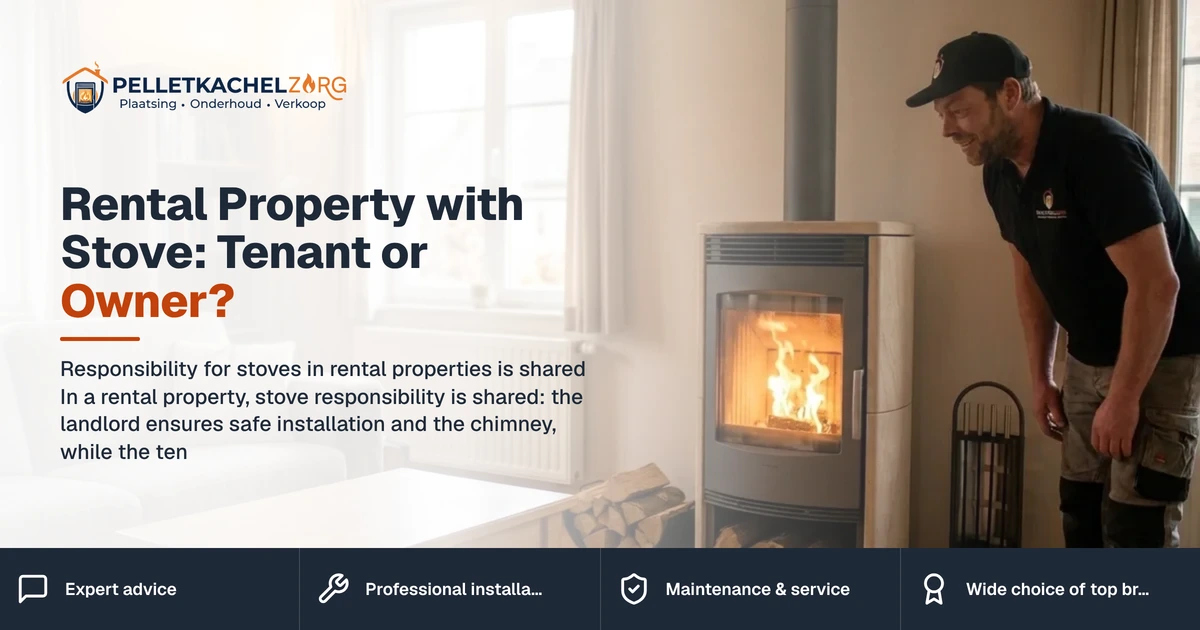
In a rental property, stove responsibility is shared: the landlord ensures safe installation and the chimney, while the tenant handles daily maintenance and chimney sweeping. The exact division varies between Belgium and the Netherlands and should ideally be clearly stated in the rental contract. A valid cleaning certificate protects both parties with the insurer.
The stove rental property responsibility is practically shared: the landlord is responsible for structural and safe installation, while the tenant handles daily maintenance and periodic sweeping. In short, the owner takes care of everything attached to the property, like the chimney and proper installation, while the tenant manages daily use. This basic rule applies to a regular wood stove as well as a pellet stove, where the chimney and proper exhaust play a bigger role.
The exact boundary differs between Belgium and the Netherlands and depends on the rental contract. When in doubt, the key question is always: is it about normal use and regular maintenance, or a structural defect affecting the property itself? In this explanation, we clearly outline who is responsible for what, so you as a tenant or owner avoid unnecessary costs or disputes.
Cleaning Certificate Included
After each cleaning, you receive a valid certificate. This proves that maintenance was correctly performed, whether you're a tenant or owner.
Neutral Advice on Responsibility
We clearly explain what falls under the tenant and what under the landlord. You know in advance who pays for what.
Safe, Inspected Installation
We check the stove and chimney for safe operation. Minor defects are immediately reported to the appropriate party.
Daily and periodic maintenance: removing ash, cleaning glass and fire basket, keeping the stove clean.
Arranging the annual chimney sweep and keeping the sweeping certificate.
Burning correctly with suitable fuel to prevent extra pollution or damage.
Minor repairs resulting from normal use, like a worn door cord or a dirty seal.
Reporting malfunctions to the landlord as soon as they occur to prevent small issues from becoming major damage.
Rule of thumb: what is used and cleaned daily is for the tenant; what is attached to the building and determines safety is for the owner.
A safe and compliant installation of the stove at the start of the rental.
The condition of the chimney and flue, including structural repairs.
Major repairs and replacements due to age or wear of the appliance.
Defects affecting safety or habitability, like a leaking or unsafe flue.
A correct property description and, where appropriate, an inspection of the stove and chimney at the start.
The stove breaks down due to normal aging: this is usually a burden for the landlord, who must repair or replace the appliance.
Damage occurs due to incorrect burning or poor maintenance: the tenant may be liable for the repair or consequential damage.
The chimney is blocked or dirty after a heating season: sweeping is the tenant's responsibility, but a structural defect in the flue remains with the owner.
The tenant wants to add a stove: this is only allowed with written permission from the owner, as it affects the structure and fire safety.
The stove was already in the property upon moving in: the property description serves as a starting point to determine what is normal wear and what the tenant has caused.
Does the rental contract specify who arranges and pays for the annual sweeping and maintenance?
Was a property description with the condition of the stove and chimney made at the start?
Does the tenant carefully keep each cleaning certificate or sweeping proof?
Do you know who the insurer contacts in case of damage and what proof they require?
Was the stove inspected for safe operation upon moving in?
The cleaning certificate is the key document that concretely defines responsibility and protects both parties. Where agreements may sometimes remain verbal and vague, this document provides a dateable and verifiable proof of the maintenance performed. After each sweep, this document proves that maintenance was carried out timely and correctly, which the tenant needs to show they fulfilled their duty. For the landlord, it is a guarantee that the installation remains maintained and the property's value is protected. Especially in the event of a chimney fire, this paper is crucial: many insurers require the certificate before paying out, and without proof, part of the damage may remain at your own expense. Therefore, keep the certificate with the rental contract, so you have it on hand in case of damage. More explanation can be found in our article about what a cleaning certificate exactly entails, and about its role in coverage, read what the insurance says about maintenance.
The main line is the same in both countries, but the legal frameworks and terms used differ. In Flanders, the rental decree assigns minor repairs and regular maintenance to the tenant, while major and structural works fall to the landlord; chimney sweeping is the tenant's responsibility. How often sweeping must occur and whether it is mandatory varies by municipality, as you can read in our overview on whether chimney sweeping is mandatory in Belgium. In the Netherlands, the Decree on Minor Repairs generally assigns chimney sweeping to the tenant, while structural defects in the flue remain with the landlord. It also applies that agreements in the rental contract and the landlord's policy determine the exact implementation. Whatever applies, the municipality, region, appliance manual, and your insurer are always the binding sources; therefore, always record the agreements made about maintenance and sweeping in writing, so there is no doubt later about stove maintenance in a rental property. For a property you rent or lease, our article provides a practical overview of who arranges which maintenance.
If you are unsure about the condition of the stove or chimney in your rental property, have the installation inspected and cleaned with a valid certificate. Request a quote or advice without obligation and you'll know exactly where you stand.
We are happy to help. Contact us without obligation.
Chimney sweeping and daily stove maintenance are usually the tenant's responsibility. The landlord remains responsible for the structural condition of the installation and chimney. Specify in the rental contract who arranges the annual sweeping certificate.
A stove that breaks down due to normal wear or a structural defect is usually the landlord's responsibility. Damage from improper use or poor maintenance can be charged to the tenant. The cause determines who pays.
Yes, as a tenant, you should carefully keep the cleaning certificate from the annual sweep. Your insurer and the landlord may request this proof after a chimney fire. Without a certificate, you risk disputes over coverage.
A tenant cannot simply install a stove or chimney without written permission from the owner. Such an action affects the structure of the property and fire safety. Always seek prior approval and have the installation done by a professional.


