
Certificate with every cleaning
You receive a valid certificate in your name after every professional cleaning. This way, you always have proof of maintenance ready for your insurer.
Have a pellet stove installed with the utmost care? Get a quote in 5 steps.
Have a pellet stove installed with the utmost care? Get a quote in 5 steps.
Have a pellet stove installed with the utmost care? Get a quote in 5 steps.

 Written by Dries Nijs3 min read
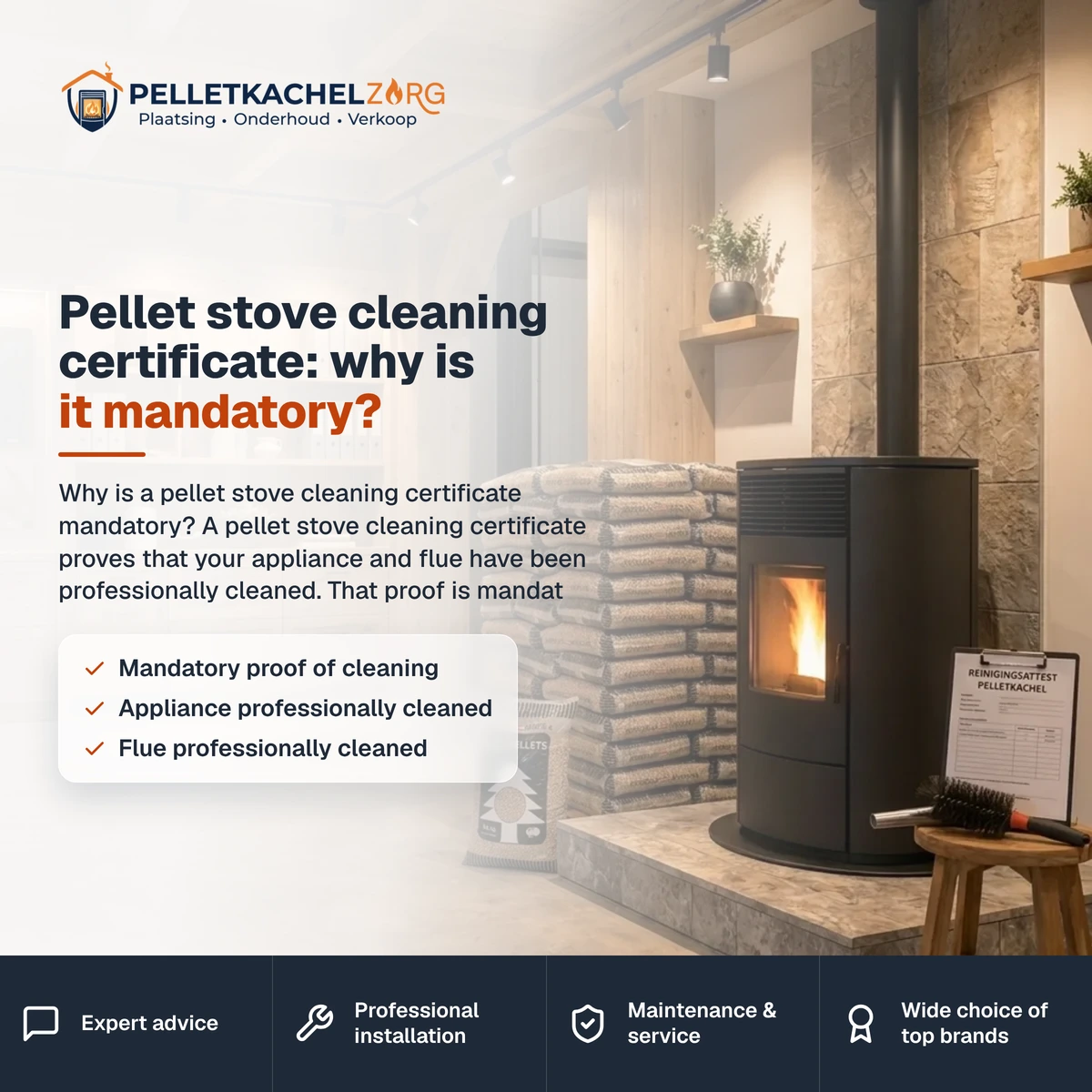
A pellet stove cleaning certificate proves that your appliance and flue have been professionally cleaned. That proof is mandatory in many municipalities and is often requested by your fire insurance in the event of a claim.
No certificate means no proof of maintenance, and that costs you coverage exactly when you need it.
A cleaning certificate proves your pellet stove and flue were professionally maintained. This document is mandatory in many Belgian municipalities and often required by fire insurance. The certificate is not a mere formality, but your legal and financial backup during damage claims.
In case of a chimney fire or smoke damage, your insurer can request this document. If it is missing, you risk a lower or denied payout. Below you can read why the certificate is crucial for a pellet stove and when you truly need it.
A pellet stove burns cleaner than wood, but still produces ash, soot and condensation in the flue. Without maintenance, this increases the risk of blockages, poor draft or fire. The certificate proves in writing that a professional handled this on time.
You only notice that difference when things go wrong. An insurer evaluates afterwards to see if you met your obligations. A dated certificate in your name is the strongest proof you can hold.
Without proof of maintenance, you are legally and financially weaker in case of damage, no matter how well your pellet stove burns.
Certificate with every cleaning
You receive a valid certificate in your name after every professional cleaning. This way, you always have proof of maintenance ready for your insurer.
Appliance and flue together
We clean both the pellet stove and the entire flue. The certificate covers both parts, just as insurance companies expect.
Clear about the rules
We explain what your municipality and region require. If in doubt, we will refer you to the correct binding source.
In the following cases, a valid certificate is often decisive. Review them to see which apply to your situation. Especially for a pellet stove, which often burns daily, recent proof of cleaning carries significant weight.
After a chimney fire or smoke damage, when your insurer requests proof of maintenance before paying out.
During a regular damage claim on your fire policy, as many policies impose periodic maintenance as a condition.
When selling your home, where a recent certificate reassures the buyer about the safety of the installation.
When renting out, where you as the owner or tenant want to record that maintenance was performed correctly.
During a municipal inspection, if they require periodic cleaning with proof.
Clarity is especially important for a rental or holiday home. The certificate shows who had the maintenance done and when. This prevents disputes between the owner and tenant regarding the responsibility for the pellet stove and flue.
A useful certificate contains more than just a signature. Check these points before filing it away.
Name and address of the owner and the cleaned appliance.
The date of cleaning and the appliance type, in this case a pellet stove.
Exactly what was cleaned, including both the stove and the flue.
Name, company and signature of the professional who performed the work.
Any findings, such as wear and tear or recommended repairs.
An invoice proves that you paid, but not what actually happened in detail. A cleaning certificate explicitly confirms that your pellet stove and flue have been professionally cleaned, which is exactly what an insurer wants to see. A payment receipt alone is usually insufficient for this purpose.
Therefore, always explicitly ask for a certificate, even if you already receive an invoice. A properly drafted certificate lists the appliance, the date and the actions performed. This leaves no doubt about what exactly was cleaned.
If you want to fully understand the difference, first read what a cleaning certificate exactly is. There is also confusion with a sweeping receipt, so feel free to check the difference between a cleaning certificate and a sweeping receipt.
The maintenance obligation and the exact format of the certificate vary by region and municipality in Belgium, and by municipality in the Netherlands. Some municipalities impose a fixed frequency, while others are more flexible. Moreover, your insurance policy can be stricter than local regulations.
Always consider your municipality, region and insurer as the binding sources, alongside the manual of your pellet stove. If you are unsure about the rules applying to your address, request them in writing and keep that response together with your certificates.
If you want to know how strict the obligation is, read whether chimney sweeping is mandatory in Belgium. Knowing what an insurance company specifically requests also helps, so read what the insurance asks after a chimney fire. For the broader picture, consult the complete guide on pellet stove maintenance.
Do you want to have your pellet stove cleaned and immediately receive a valid certificate in your name? Request a free quote or advice and you will know exactly where you stand.
We are happy to help. Contact us without obligation.
In many Belgian municipalities and regions, periodic cleaning with a certificate is mandatory, but the exact rule varies by municipality and region. Ask your local authority for the rules and read your insurance policy, as it may impose a stricter maintenance requirement.
Without a certificate, it is difficult to prove that you maintained your pellet stove after a chimney fire or smoke damage. Your insurer could then lower or deny the payout, depending on your policy and the circumstances.
A cleaning certificate applies to one cleaning session and is usually valid until the next mandatory cleaning, often one heating season. Always keep the most recent certificate, as your insurer and municipality look at the last valid maintenance.
When selling or renting out, a recent cleaning certificate is highly recommended and sometimes even required. It shows the new resident or tenant that the pellet stove and flue are safe and well-maintained.