
Specialists in heating and flues
You get advice from a team that works with stoves and flues daily. We know exactly which fuel suits which installation.
Have a pellet stove installed with the utmost care? Get a quote in 5 steps.
Have a pellet stove installed with the utmost care? Get a quote in 5 steps.
Have a pellet stove installed with the utmost care? Get a quote in 5 steps.

 Written by Dries Nijs4 min read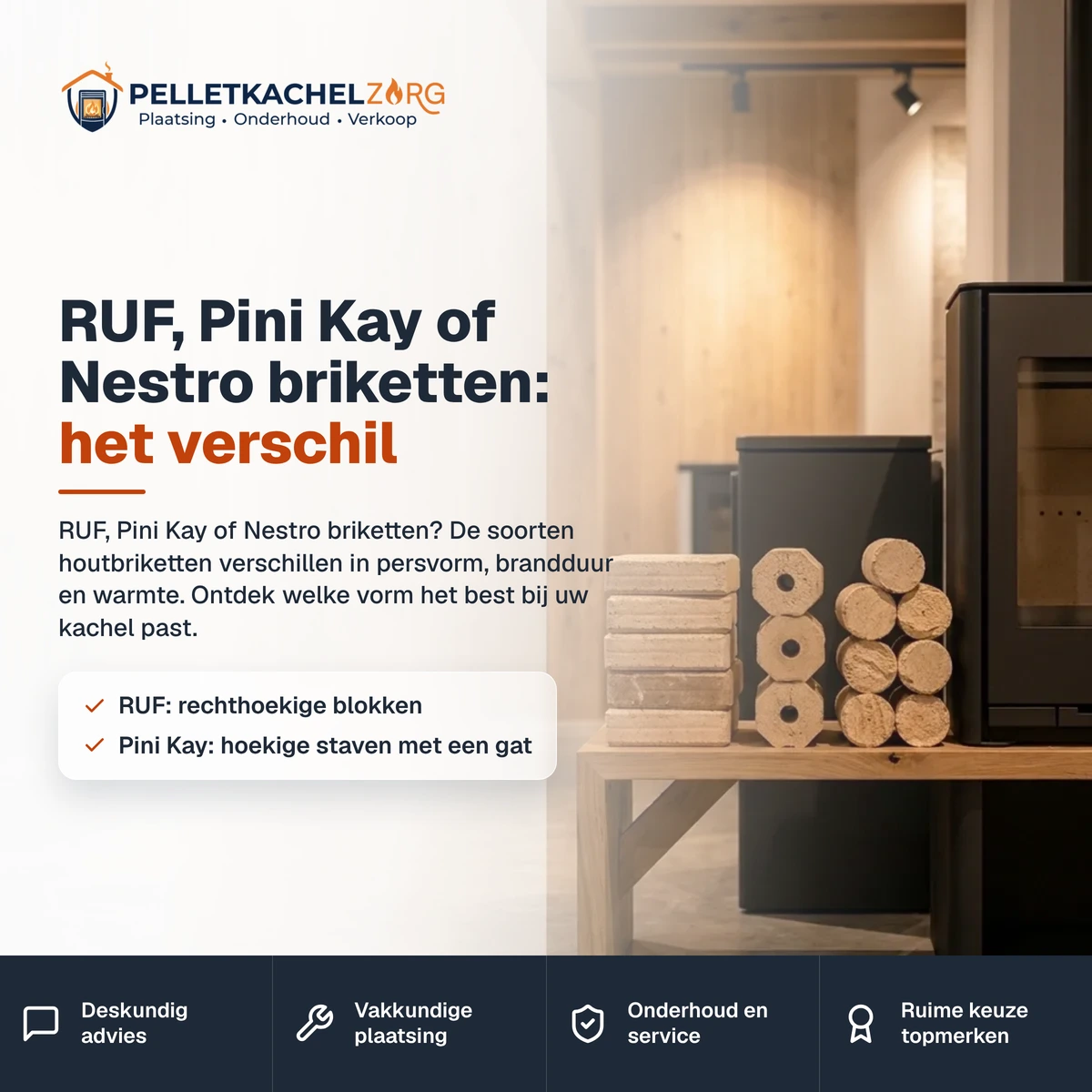
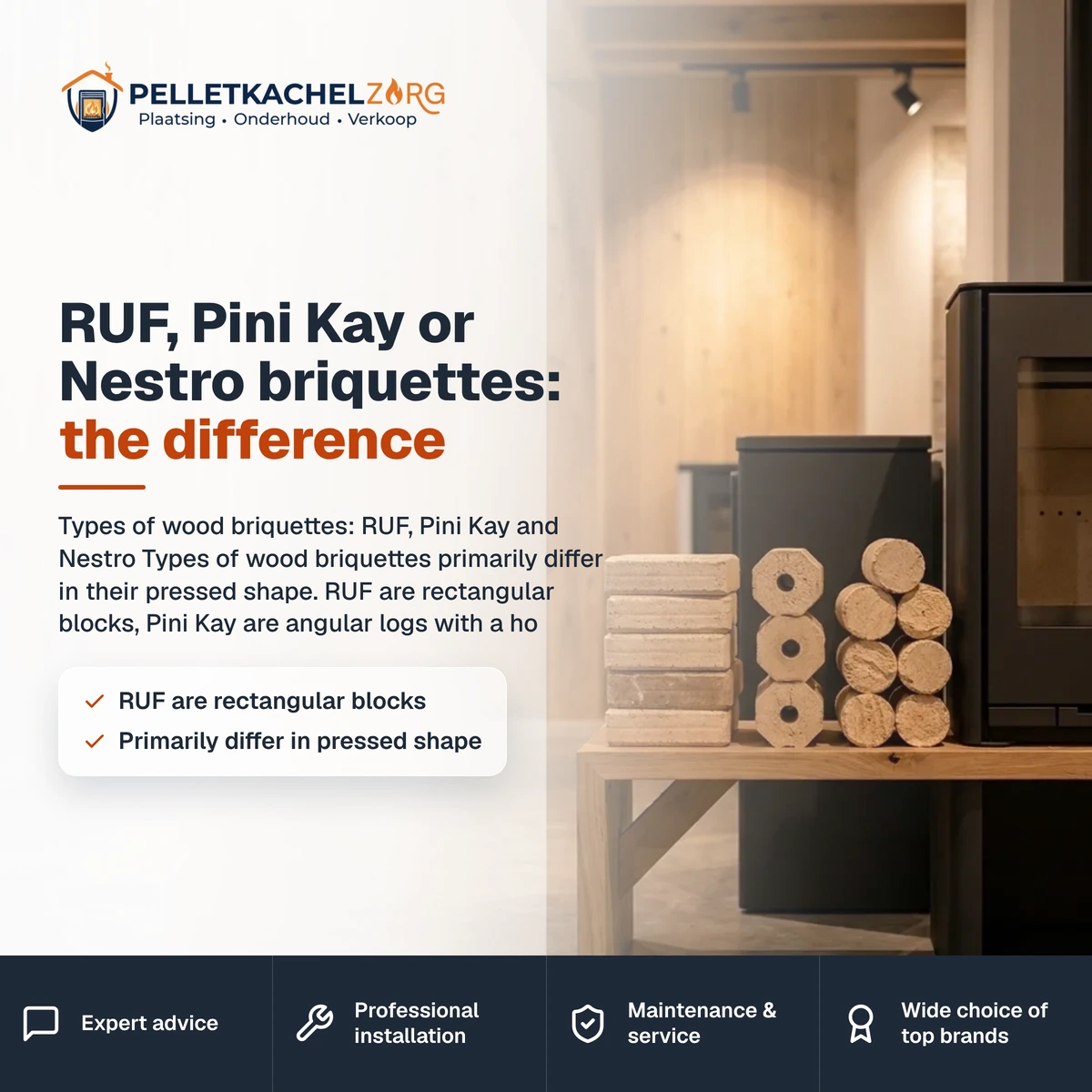
Types of wood briquettes primarily differ in their pressed shape. RUF are rectangular blocks, Pini Kay are angular logs with a hole, and Nestro are round cylinders. The shape determines the burning behavior, while wood type and moisture dictate quality.
Choose the shape
for your heating habits, and always pay attention to moisture content and wood type.
Wood briquette types vary mostly in their pressed form. RUF, Pini Kay, and Nestro are the three names you will encounter most often. These names do not refer to the wood species, but rather to the way the compressed sawdust is shaped.
RUF are rectangular blocks, Pini Kay are angular logs with a central hole, and Nestro are round cylinders. Each shape burns slightly differently in terms of burn time, heat output, and ash residue. Below, you can read the characteristics of each type, along with a practical guide to choosing the right one for your stove or fireplace. Besides the first two, you might also know Nestro briquettes. These are round cylinders, sometimes featuring a small hole, widely available at an attractive price point. They burn smoothly and cleanly, making them an excellent choice for daily heating.
The shape primarily determines the burn behavior, while the wood type and moisture content dictate the quality.
Specialists in heating and flues
You get advice from a team that works with stoves and flues daily. We know exactly which fuel suits which installation.
Honest advice on fuel
We do not sell fairy tales. We explain what shape, wood type, and moisture truly mean, so you make an informed choice.
Experience in the local area
As local specialists, we see the practical consequences of poor fuel. We are happy to pass that knowledge on to you.
In practice, four features matter most: burn time, heat output, ash residue and ease of use. Thanks to their high compression density and central hole, Pini Kay briquettes score best on burn time and peak heat.
RUF provides a calmer, more consistent heat and is the easiest to stack and dose due to its block shape. Nestro sits right in the middle, offering a smooth, affordable base fire for everyday use.
For all three shapes, the ash residue mainly depends on the purity of the wood. Pure, untreated material without binders leaves very little ash, whether you use a block, a log or a cylinder.
There is no absolute winner, as the best briquette depends on how you burn and for how long. The steps below will quickly guide you toward the right choice.
If you want neat stacking and a calm, even burn, choose RUF blocks.
If you want to burn as long and hot as possible, for example an entire evening, go for Pini Kay.
If you are looking for a standard briquette at a great price for daily use, pick round Nestro cylinders.
If you are still in doubt, buy a small sample pack of each type and test them in your own stove.
Whatever your choice, always check the compression density and stated moisture content first, not just the shape.
Wood briquettes are meant for a wood stove, a built-in fireplace or an open fire, not for a pellet stove. A pellet stove automatically feeds small pellets and cannot handle large blocks or logs.
In a wood stove, you place the briquettes on a glowing bed just like regular firewood. Leave some space between the pieces so the air can flow freely and the briquette ignites evenly.
If you are unsure whether your appliance is suitable, check your stove manual. It will state which fuels the manufacturer allows and which sizes fit.
A shape that matches your stove and heating habits, meaning RUF, Pini Kay or Nestro.
Wood type, because pure hardwood generally provides more heat per kilo.
A moisture content of about 10 percent or lower for a clean burn.
No glue residues or strange binders, just compressed sawdust.
Packaging that is dry and intact, since damp briquettes will fall apart.
Price per kilo rather than per pack, so you can compare prices fairly.
In terms of use, wood briquettes sit between loose firewood and pellets. They are drier and more densely compressed than regular firewood, meaning they burn cleaner and more consistently.
Compared to pellets, briquettes are larger and suited for manual firing rather than automatic feeding. Every fuel type therefore has its own specific stove and use.
If you want to know how briquettes compare to classic firewood, read wood briquettes or firewood, which burns better. Those focused on efficiency and less smoke will find guidance in choosing fuel for less smoke and better efficiency.
The compressed shape determines the burning behavior, but true quality lies in the wood type and moisture content. Even the finest Pini Kay log burns poorly if the raw material was too damp.
Damp or contaminated briquettes produce more smoke and more soot in your chimney. You can read why wet material is so harmful in why wet wood is bad for your chimney.
Therefore, ideally buy briquettes from a source that lists the wood type and moisture content. A low price means little if you do not know exactly what is inside the briquette.
Furthermore, always fire safely, regardless of the shape you choose. You can find practical rules in safe firing with wood or pellets. If you also use pellets, keep them dry as described in how to store wood pellets dry.
Do you want to be sure which briquettes or fuel best suit your stove and chimney? Request a free quote or advice and you will receive a specific, tailored proposal.
We are happy to help. Contact us without obligation.
RUF briquettes are rectangular, stackable blocks providing a steady, even burn. Pini Kay briquettes are angular logs with a central hole and a charred outer layer, allowing them to burn longer and hotter. RUF is convenient to use, while Pini Kay offers the longest burn time.
Pini Kay briquettes typically burn the longest and hottest. The hole in the middle provides extra air supply, and the very high density retains the embers for a long time. For a full evening of heating, they are often the best choice.
No, Nestro briquettes are not automatically of lower quality. They are round cylinders that are widely and affordably available, and they burn smoothly. The quality depends mainly on the wood type and moisture content, not on the round shape.
High-quality wood briquettes have a moisture content of around 10 percent or less. Drier material burns cleaner, produces more heat, and causes less buildup in your flue. Therefore, always check the specified moisture content on the packaging.