
Tailored Advice
You receive a realistic estimate of your consumption based on your home and stove. This way, you know in advance approximately how many pellets you will need.
Have a pellet stove installed with the utmost care? Get a quote in 5 steps.
Have a pellet stove installed with the utmost care? Get a quote in 5 steps.
Have a pellet stove installed with the utmost care? Get a quote in 5 steps.

 Written by Dries Nijs4 min read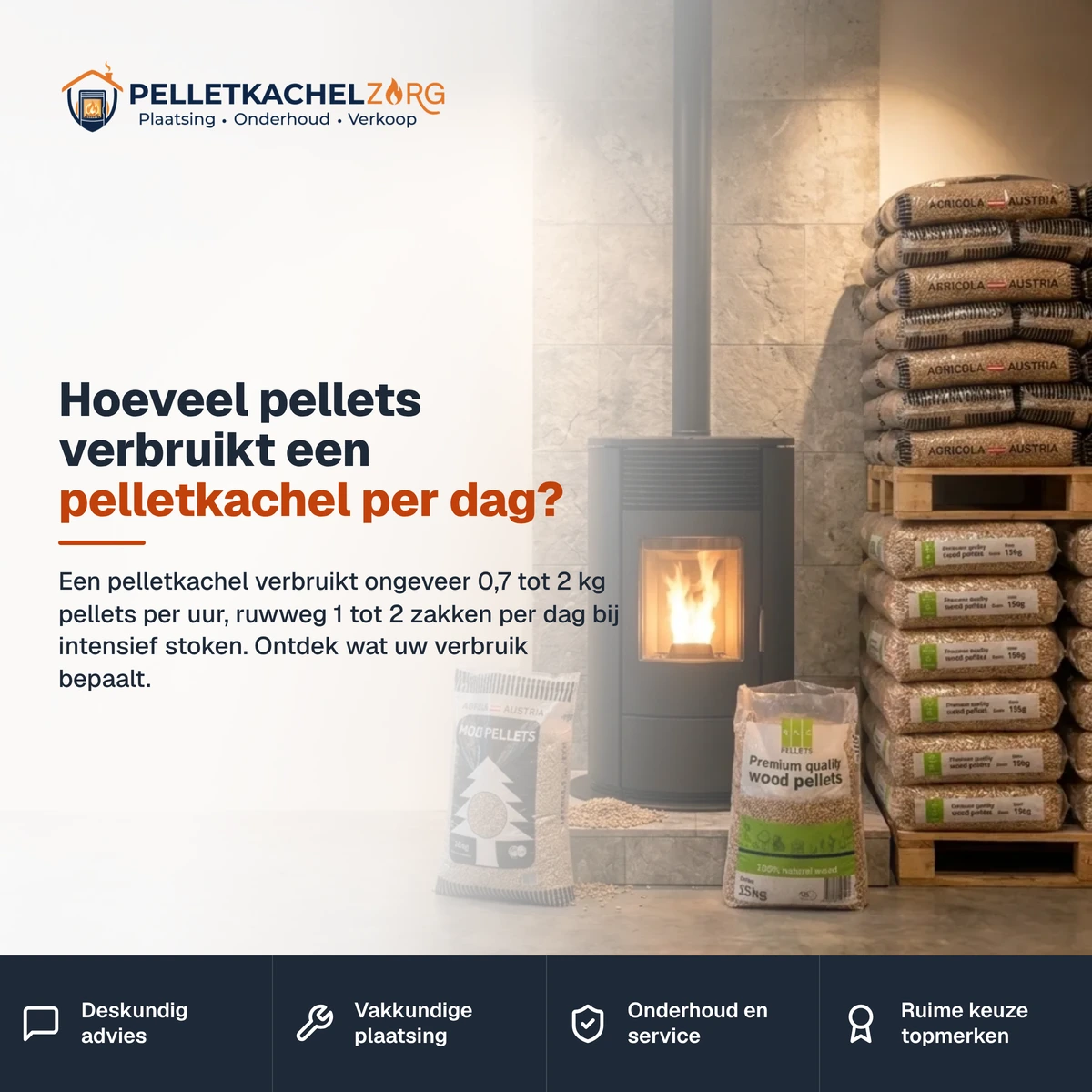
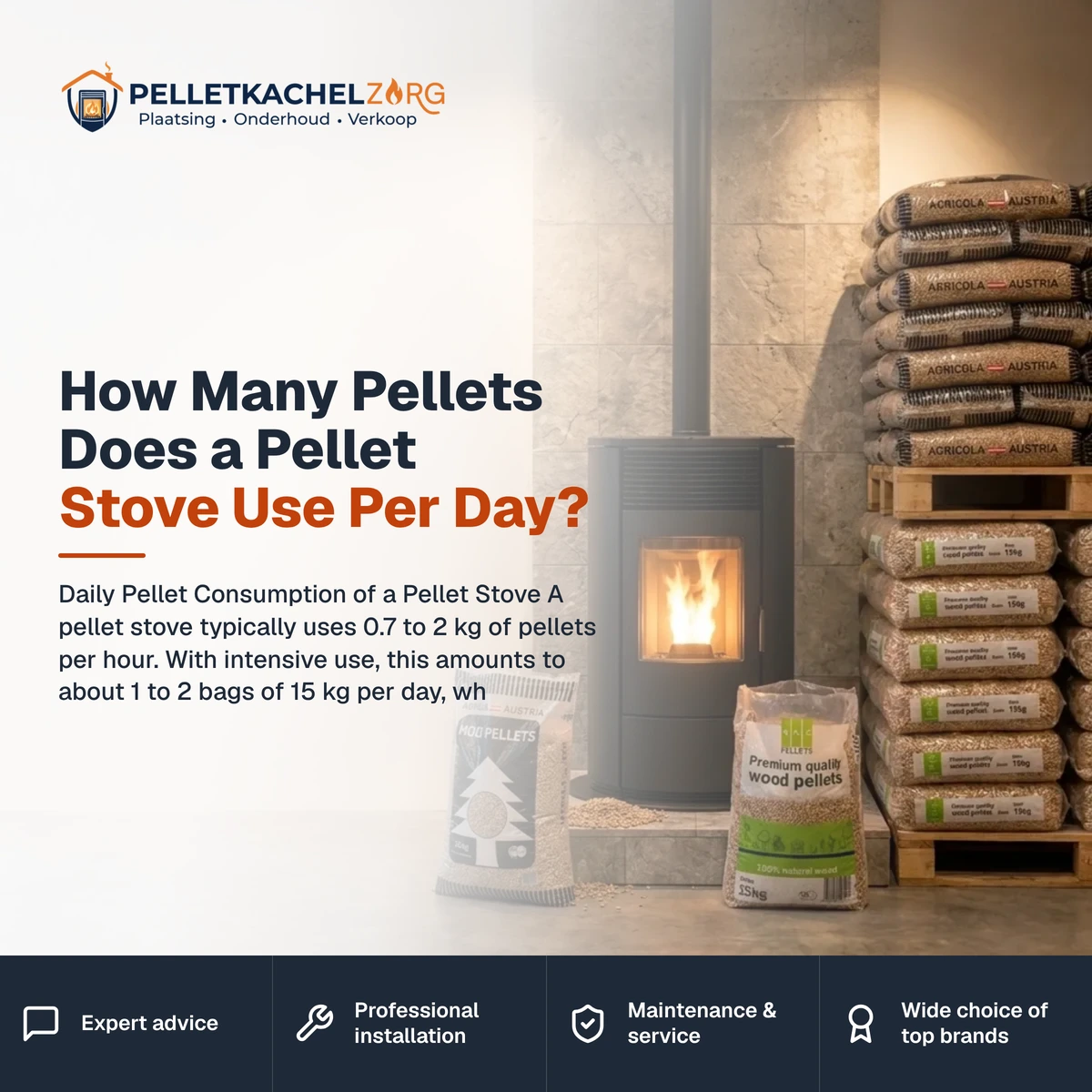
A pellet stove typically uses 0.7 to 2 kg of pellets per hour. With intensive use, this amounts to about 1 to 2 bags of 15 kg per day, while economical use often stays below 1 bag.
Your actual consumption depends on power, burning hours, insulation, and desired temperature.
A pellet stove typically uses about 0.7 to 2 kg of pellets per hour, depending on the power and setting chosen. With a few hours of use, the daily pellet consumption roughly equates to 1 to 2 bags of 15 kg with intensive use. Economical use often stays below 1 bag per day. Actual consumption depends on power, burning hours, insulation, and desired temperature.
The figures in this article are guidelines. They help you form an expectation, but your situation may vary. Consider them a starting point, not a fixed guarantee.
The difference between economical and intensive use greatly determines your daily consumption. The comparison below shows two usage patterns with corresponding guidelines, so you can quickly see where your own usage lies. Many households fall somewhere between these two extremes. During the transitional season, you usually use less, while consumption is clearly higher during the coldest weeks. Keep this in mind when stocking up on pellets.
Estimate globally with half to two bags of 15 kg per day, depending on how hard and how long you use it.
Tailored Advice
You receive a realistic estimate of your consumption based on your home and stove. This way, you know in advance approximately how many pellets you will need.
Properly Adjusted Stove
A well-adjusted pellet stove uses fuel more efficiently and consumes less. We ensure your appliance burns economically and safely.
Maintenance That Limits Consumption
Regular maintenance keeps combustion clean and consumption low. This way, you avoid unnecessarily high pellet costs.
Power and setting: a stove on a high setting requires more pellets per hour than the same unit on a low setting. The setting you choose daily weighs more than the maximum power.
Number of burning hours: the longer you use it per day, the higher the total consumption. Two hours of supplementary heating logically costs much less than a full day of main heating.
Insulation and volume: a poorly insulated or large space requires more heat and thus more pellets. In a well-insulated home, you retain heat longer.
Desired temperature: each extra degree of comfort noticeably increases consumption. A target temperature of 23 degrees clearly costs more than 20 degrees.
Quality of the pellets: dry, certified pellets provide more heat per kilo than moist or inferior pellets. This allows you to reach the same temperature with less fuel.
Maintenance and adjustment: a clean, well-adjusted stove uses fuel more efficiently. Dirt or incorrect adjustment can unknowingly increase consumption.
Suppose your pellet stove consumes an average of 1.3 kg of pellets per hour and you use it for six hours a day. This amounts to about 7.8 kg per day, or slightly more than half a bag of 15 kg.
If you use it for ten hours on a higher setting of 1.7 kg per hour, consumption rises to about 17 kg per day. That's more than one bag. This shows how strongly burning hours and setting influence the end result.
With a few simple habits, you can keep consumption under control without sacrificing comfort. Check the points below.
Switch to a lower setting once the room is at temperature
Choose a stove with power suitable for your home
Use certified pellets with low moisture content
Keep the fire basket and heat exchanger clean
Close doors and limit heat loss to cold areas
Use a room thermostat or program to avoid unnecessary heating
Poor or moist pellets increase your consumption because the stove needs to supply more fuel for the same heat. Choose wisely and read which pellets are best, for example, through our article on which pellets are best for your pellet stove. Also, store the bags dry, as moisture reduces the combustion value, as you can read in how to store wood pellets dry.
A stove that requires too many pellets often doesn't burn as it should. For ongoing issues, the explanation about a pellet stove that burns poorly or produces a lot of soot can help find the cause and bring your consumption back to a normal level.
Your daily consumption directly translates to your annual costs. You can make a realistic estimate with the overview of pellet stove consumption and costs per year. Prices per bag or pallet vary greatly between suppliers in Belgium and the Netherlands, so always calculate with your own rate and usage pattern.
Power also plays a role, as an oversized stove often runs on a low, less efficient setting. Therefore, check how many kW your pellet stove needs for your home, so consumption and comfort remain balanced.
Remember that all mentioned figures remain guidelines. Your actual consumption varies per home, stove, and winter, so adjust your expectation based on your first weeks of use.
Want to know for sure what consumption suits your home and stove? Request a quote or advice and get a realistic estimate tailored to you.
We are happy to help. Contact us without obligation.
Expect about 1 to 2 bags of 15 kg per day with intensive use as main heating. If you use it for a few hours on a lower setting, you often stay below 1 bag per day.
A pellet stove typically uses 0.7 to 2 kg of pellets per hour. On a low setting, it's around 0.7 to 1 kg, while on a high setting, it can reach about 2 kg per hour.
Yes, on a lower setting, your pellet stove uses fewer pellets per hour. Turn the stove down once the room is at temperature to keep consumption under control without sacrificing comfort.
A stove with more power can burn more pellets per hour, but it mainly depends on the setting you use. An oversized stove on a low setting often burns less efficiently, making consumption less favorable.