
Advice according to regulations
We determine the proper diameter based on manual guidelines and building regulations, ensuring a safe and leak free installation.
Have a pellet stove installed with the utmost care? Get a quote in 5 steps.
Have a pellet stove installed with the utmost care? Get a quote in 5 steps.
Have a pellet stove installed with the utmost care? Get a quote in 5 steps.

 Written by Dries Nijs4 min read
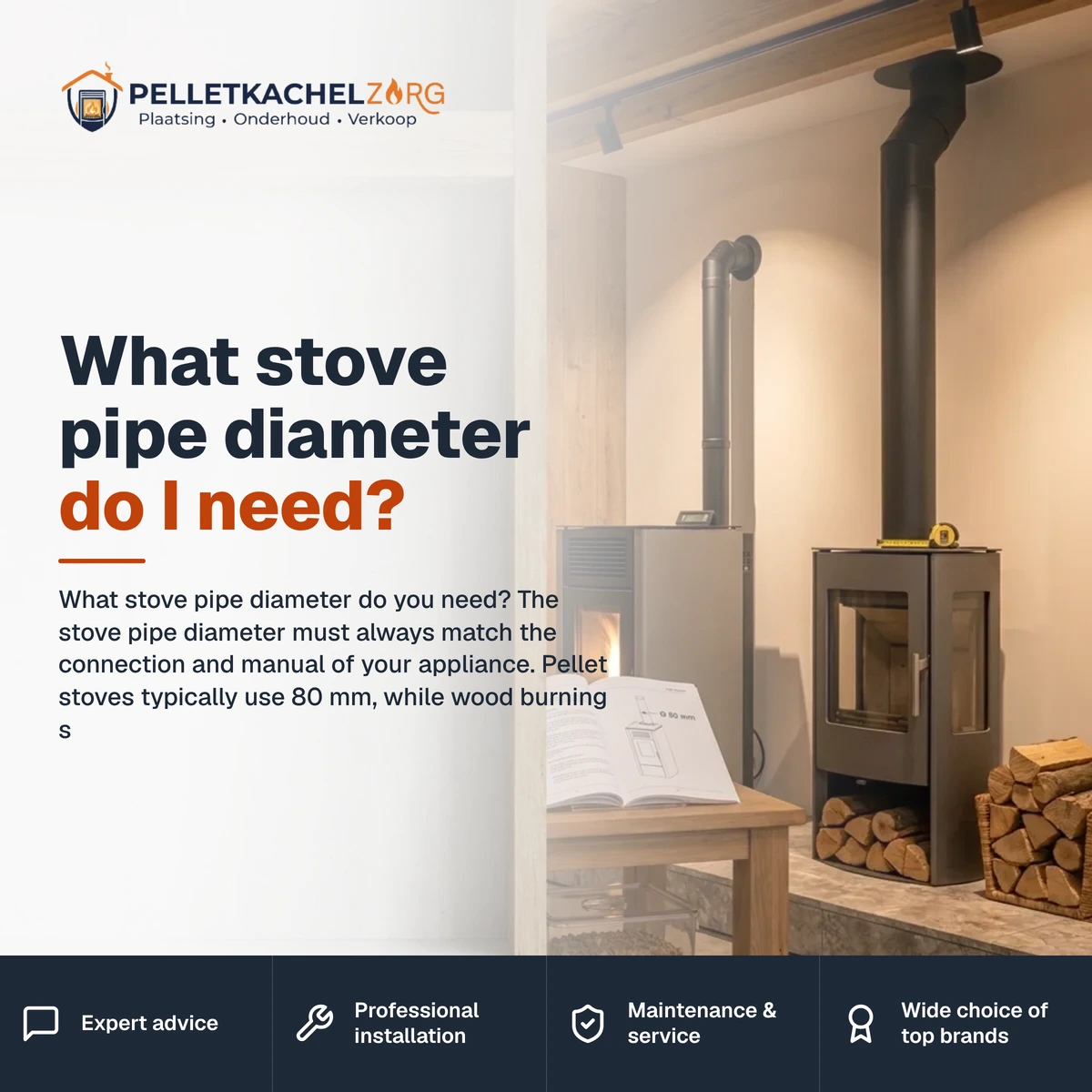
The stove pipe diameter must always match the connection and manual of your appliance. Pellet stoves typically use 80 mm, while wood burning stoves usually require 120 to 150 mm. Never reduce or enlarge this size without proper calculations.
The right size is always the size specified by your manufacturer.
The right stove pipe diameter matches the flue outlet and manual of your appliance, never reduce or enlarge it arbitrarily. A pellet stove usually uses 80 mm, while a wood stove typically requires 120 to 150 mm. The manufacturer calculates this size based on heat output and flue gas dynamics. Deviating from it disrupts draw and safety. Read on to discover how to select the correct size.
An incorrect stove pipe diameter leads to two opposite problems. Both disrupt flue gas extraction and the safe operation of your appliance.
The diameter determines how smoothly flue gases flow through the pipe. With the correct diameter, gases stay warm and rise with a steady draught. If the size deviates, this balance breaks down, resulting in smoke, soot, or poor combustion.
A pipe that is too wide may seem safe, but it causes flue gases to cool down too fast. This creates condensation and creosote, weakening the draught. Conversely, an oversized reduction chokes the exhaust and restricts airflow.
The ideal diameter keeps flue gases warm enough to rise smoothly to the outside. Always work with the outlet size of your stove, rather than pipes you happen to have lying around. A cheap workaround will cost you later in poor burning performance, soot build up, and frequent cleaning.
Follow your stove size, an incorrect diameter cannot be fixed with an adapter.
Advice according to regulations
We determine the proper diameter based on manual guidelines and building regulations, ensuring a safe and leak free installation.
Pellet and wood stove expertise
We understand the specific demands of pellet and wood burning stoves, providing the exact sizing tailored to your system.
Professional installation and inspection
We install and inspect your complete flue system, delivering efficient performance and reliable draught for your home.
Choosing the right diameter is not a guessing game, it depends directly on your appliance and flue run. Follow these steps in order.
Locate the flue outlet diameter in your appliance manual.
Use the specified size as your baseline, usually 80 mm for pellet stoves and 120 to 150 mm for wood burners.
Take into account the output in kW, total height, and length of the flue run.
Maintain this diameter along the entire flue and avoid any reductions.
If in doubt, have the dimensions calculated by a qualified specialist according to regulations.
The flue outlet size is your primary reference point. The heat output determines how much flue gas your stove produces, while flue height and bends create flow resistance. A professional balances these factors to select a safe flue diameter.
Review these points before ordering or installing any flue components.
Flue outlet size identified
Manual and heat output in kW checked
Flue height and length evaluated
No arbitrary reductions or expansions in the system
Professional calculation requested when uncertain
The required diameter depends heavily on the type of stove you own. A pellet stove operates with forced exhaust via a fan and uses a narrower pipe, usually 80 mm. A wood burning stove relies on natural draught and requires a larger pipe, typically 120 to 150 mm. In both cases, the manufacturer defines the outlet size.
These numbers serve as general guidance rather than a rigid rule for every single model. High output wood stoves or inset fires may require different dimensions than a compact freestanding model. Always verify the rating plate and manual of your specific appliance.
A general rule of thumb is a good starting point, but never a substitute for official specifications. Two stoves with identical heat output may feature different flue collar sizes. Always follow your appliance specifications and do not alter diameters to fit spare parts you already own.
Heat output, total stack height, and flue runs all impact performance. A tall, straight flue creates a stronger pull than a short system with multiple bends. However, your stove outlet remains the starting point, never install a wider pipe simply to compensate for poor natural draught.
To learn which flue system fits your setup, read our guide on which flue system you need for a pellet stove or which flue system you need for a wood stove. This ensures you match the correct diameter with the right flue material.
When connecting to an existing masonry chimney, its internal dimension plays a crucial role. If the chimney is too wide for your pellet stove, a professional installer will insert a stainless steel flexible liner with the appropriate diameter. This maintains flue gas temperature without demolishing existing structures.
The flue diameter is closely tied to system materials and layout. If sized incorrectly, flue gases cool down rapidly, causing moisture and creosoot build up. Choosing between a single wall or twin wall insulated flue helps prevent excessive cooling.
Proper moisture management is vital for pellet appliances. Read why condensate collection is essential for pellet stoves before assembling your pipework. Follow NBN standards in Belgium and local regulations in the Netherlands. When unsure, ask an expert to calculate the precise dimensions.
Building standards and insurers demand a correctly installed flue system with accurate sizing. An incorrect diameter will fail inspection and may jeopardize insurance coverage in the event of an incident. Selecting the correct diameter protects both your draught and your safety.
Not sure about the ideal stove pipe diameter for your installation? Request a free quote or expert advice and we will verify the exact dimensions for you.
We are happy to help. Contact us without obligation.
A pellet stove usually requires an 80 mm pipe because exhaust gases are force-extracted by an internal fan. Your manual specifies the exact sizing, which must be maintained along the full flue run.
No, you should never reduce or enlarge a stove pipe without expert advice. A narrower pipe chokes exhaust flow, while an oversized pipe cools flue gases, leading to condensation. Always follow the appliance collar size.
Wood burning stoves typically require a 120 to 150 mm diameter pipe, relying on natural thermal draught. The manufacturer determines the outlet size based on heat output, which must be kept consistent throughout.
If a stove pipe is too wide, flue gases cool down too rapidly. This creates condensation and creosote build up while reducing natural draught, resulting in poor combustion and increased risk of chimney fires.