
Output tailored to your home
We determine required output based on volume, insulation, and age of property. You get a stove that fits your space perfectly without smothering.
Have a pellet stove installed with the utmost care? Get a quote in 5 steps.
Have a pellet stove installed with the utmost care? Get a quote in 5 steps.
Have a pellet stove installed with the utmost care? Get a quote in 5 steps.

 Written by Dries Nijs3 min read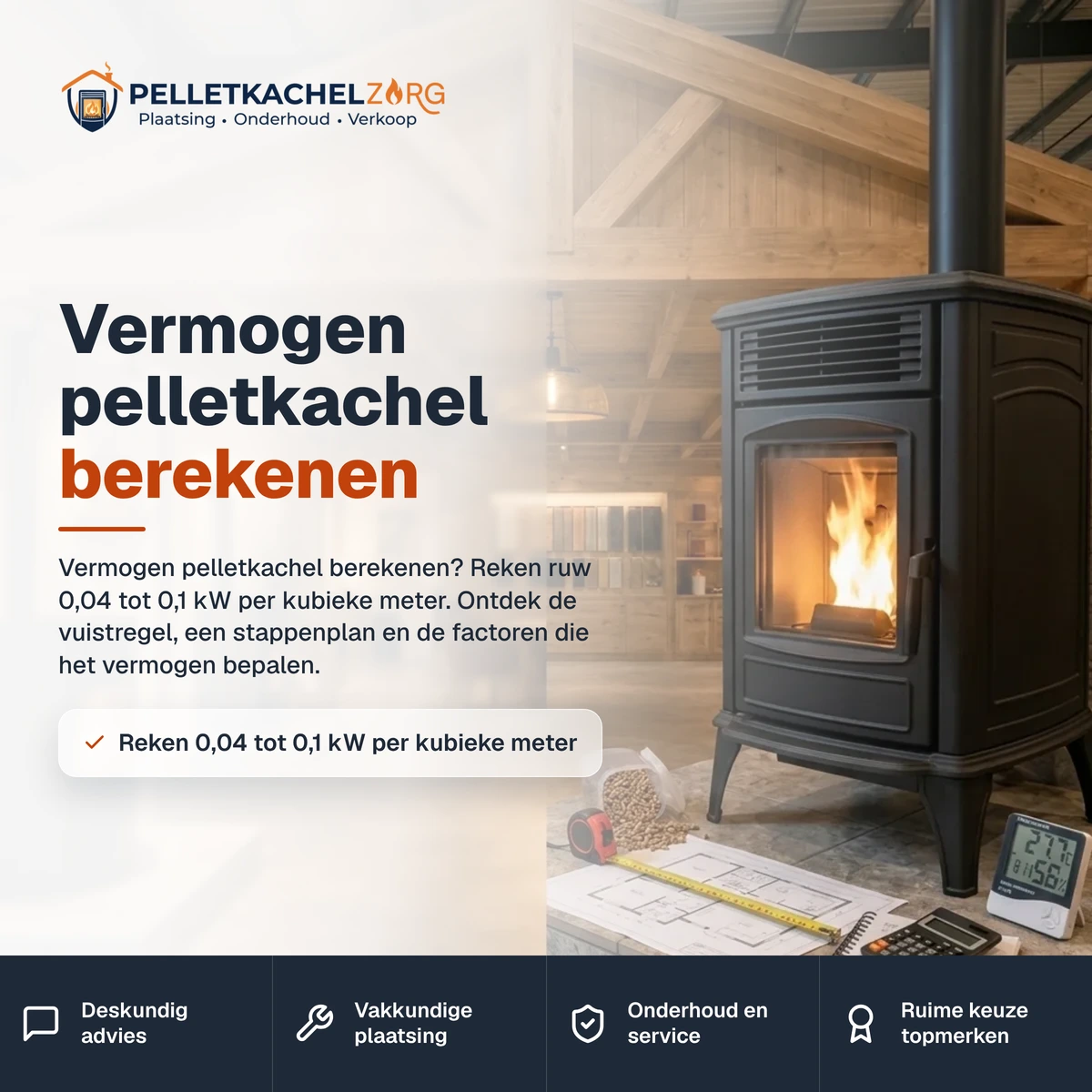
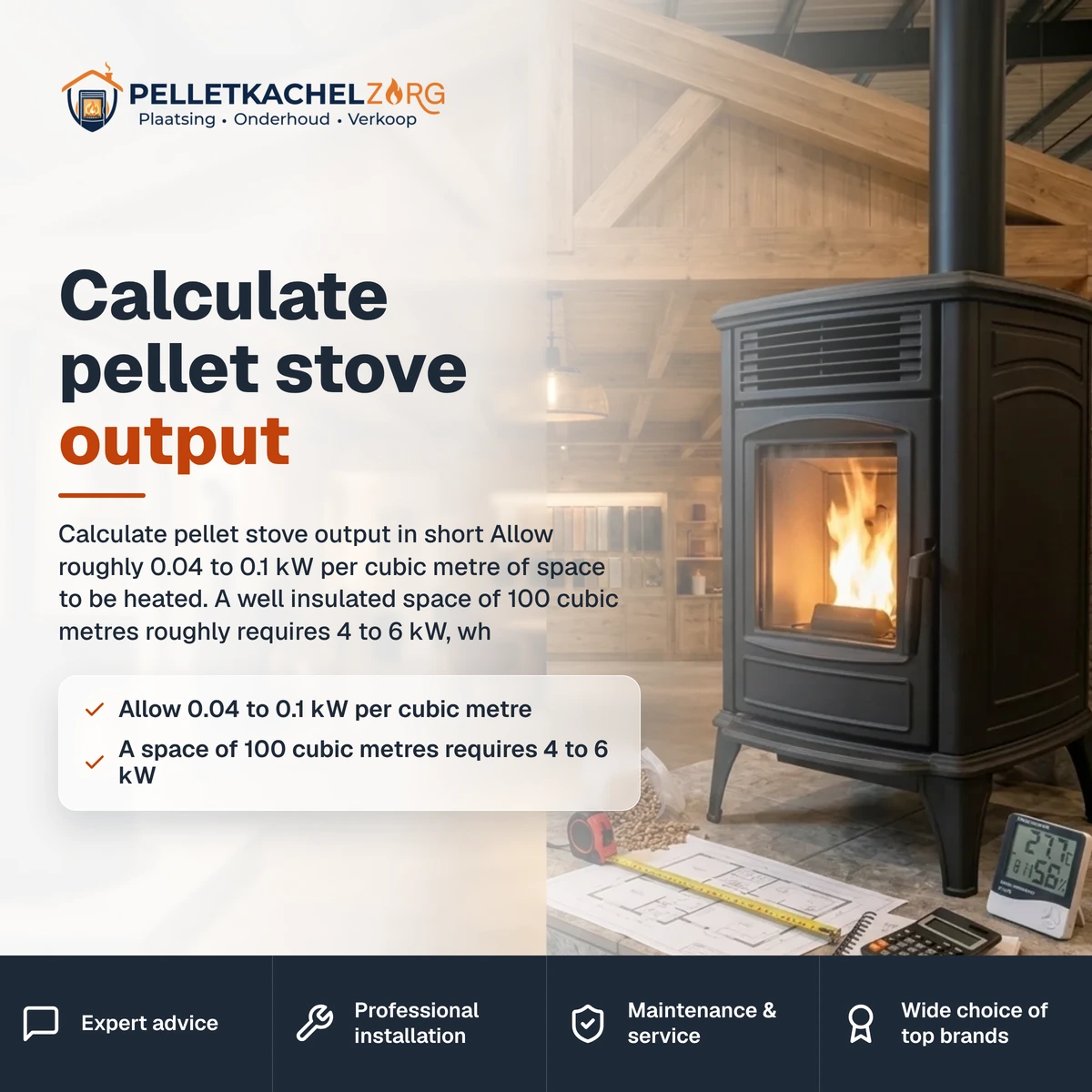
Allow roughly 0.04 to 0.1 kW per cubic metre of space to be heated. A well insulated space of 100 cubic metres roughly requires 4 to 6 kW, whereas moderate insulation increases this demand.
Better to choose slightly too small than too large, as an oversized stove smothers and produces soot.
To calculate the output of a pellet stove, calculate roughly 0.04 to 0.1 kW per cubic metre of space to be heated, depending on insulation. A well insulated space of 100 cubic metres requires roughly 4 to 6 kW. With moderate insulation, this figure is noticeably higher. Use this rule of thumb as a starting point, not a final choice.
Better to choose a stove that keeps your room warm on a low setting, than an oversized appliance that requires constant smothering.
Measure the floor area in square metres of the space you want to heat. Include only the zone the stove actually needs to heat.
Multiply this area by the ceiling height. This gives you the volume in cubic metres, which forms the basis for the calculation.
Choose your insulation factor. Allow 0.04 to 0.06 kW per cubic metre for good insulation and 0.07 to 0.1 kW for moderate insulation.
Multiply the volume by this factor. The result is the estimated output in kW required for your room.
Add a little extra for an open staircase, high pitched ceiling, or if the pellet stove serves as the primary heating source.
Round off to an existing stove model and pay attention to the modulation range, ensuring the appliance burns cleanly on a low setting.
Output tailored to your home
We determine required output based on volume, insulation, and age of property. You get a stove that fits your space perfectly without smothering.
Correct installation and flue connection
Beyond output, we inspect room placement and flue setup. Proper installation ensures heat circulates effectively throughout the room.
Free advice and non-binding quote
You receive a clear calculation and price estimate with no obligation. Know in advance which stove and costs fit your property.
Year of construction and insulation level of the property
Type of glazing: single, double, or triple glazing
Ceiling height and actual volume, not just floor area
Number of external walls and orientation of the room
Open connections to hallway, stairs, or adjoining rooms
Whether the stove serves as primary heating or secondary heating
Desired comfort temperature and your local climate area
An oversized output actually works against you in practice. The stove quickly reaches the target temperature and must then modulate down to a low setting. At this low setting, the pellet burns less cleanly.
This causes soot, blackened glass, and deposits in the flue, reducing efficiency and increasing maintenance frequency. An undersized output is also far from ideal, as the stove runs constantly on its highest setting and fails to reach the target temperature during severe frost.
A stove tailored correctly to the room burns more smoothly and efficiently. To make sure you pick the right size, read how to determine which pellet stove suits your home best.
An example makes it clear. For a well insulated living room of 40 square metres with a ceiling height of 2.6 metres, you reach roughly 104 cubic metres. Using a factor of 0.05 kW gives an estimated benchmark of 5 kW.
Whether the pellet stove acts as your primary heating or secondary heating changes the calculation significantly. As primary heating, the appliance must bring the entire living area up to temperature, even on the coldest days.
In this case, calculate towards the higher end of the rule of thumb and keep a small reserve. That way, the stove does not need to run on full power for hours to maintain comfort.
As secondary heating alongside central heating, the required output can be smaller. The stove then provides a warm focal point in the living room while the rest of the house uses central heating.
A stove with ducting or a wide modulation range helps direct heat more effectively. Weigh these factors carefully before deciding on a fixed number.
The calculated output is an estimate, not a final verdict. Position inside the home also dictates how heat spreads. A central location distributes heat much better than placing the stove in a corner or behind a wall.
Be sure to read what the best location for a pellet stove in your home is. In our guide on installing a pellet stove, you will find key points regarding flues, clearance to combustibles, and connections.
If you hesitate between two stove outputs, choose the model whose lowest setting best suits a mild day. Comfort is more often compromised by an oversized stove than by a slightly smaller one.
This ensures both the output and installation are correct. Regulations and clearance distances vary by region, so always check your plan against the appliance manual and local building codes. A quick check beforehand prevents replacing an incorrectly sized appliance later.
Treat your calculation as a guide and have the final output determined based on your specific home. For insight into costs, check the price to install a pellet stove in Belgium. Request a non-binding quote or advice and we will verify the required output with you.
We are happy to help. Contact us without obligation.
For 50 square metres with a 2.5 metre ceiling, you reach roughly 125 cubic metres. Good insulation requires about 5 to 7 kW, while moderate insulation needs 9 to 12 kW. Always measure volume, not just floor area.
Yes, an oversized output is usually detrimental. The appliance must often smother on a low setting, resulting in soot, blackened glass, and lower efficiency. A stove sized correctly for the room burns cleaner and more efficiently.
Room volume in cubic metres matters, not just floor area. Multiply floor area by ceiling height. Especially with high ceilings or open eaves, this makes a significant difference to the required output.
You can make a good estimate yourself using the rule of thumb of 0.04 to 0.1 kW per cubic metre. For the final output rating, it is best to have your insulation, windows, and layout professionally assessed.