

Advice Tailored to Your Home
We assess your space, flue, and heating habits. This way, you won't buy a stove that's too large or too cheap and disappointing later.
Have a pellet stove installed with the utmost care? Get a quote in 5 steps.
Have a pellet stove installed with the utmost care? Get a quote in 5 steps.
Have a pellet stove installed with the utmost care? Get a quote in 5 steps.

 Written by Dries Nijs4 min read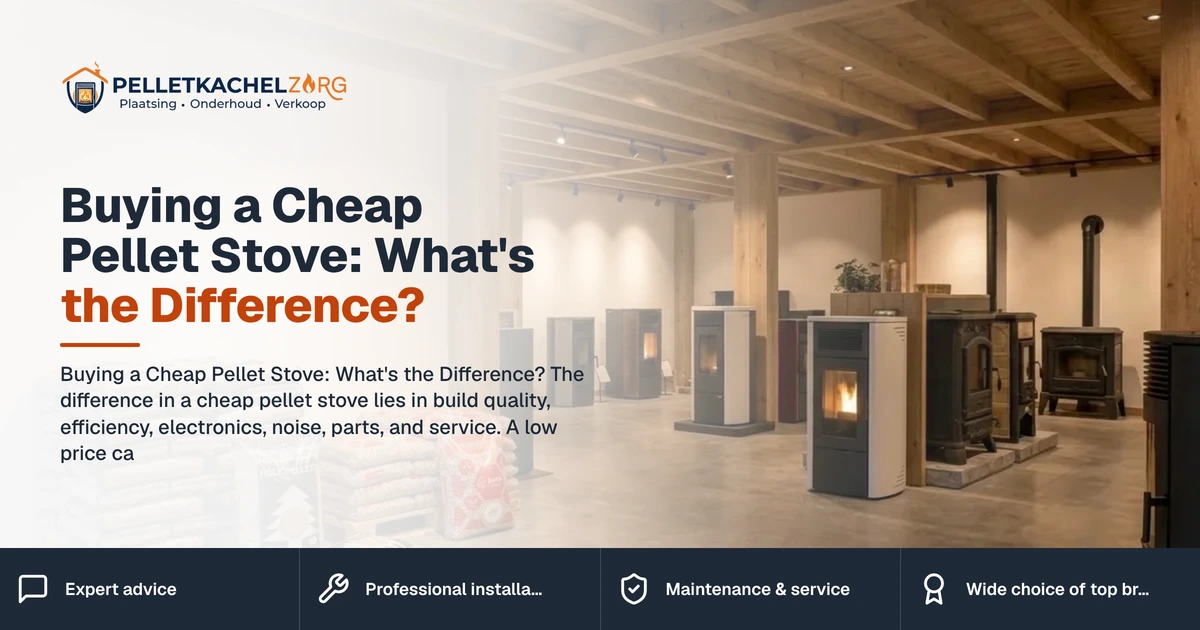
The difference in a cheap pellet stove lies in build quality, efficiency, electronics, noise, parts, and service. A low price can end up being more expensive due to higher consumption and malfunctions.
It's not the lowest price that counts, but the lowest cost over the entire lifespan.
When buying a cheap pellet stove, the difference is mainly in the build quality, efficiency, control and electronics, noise production, availability of parts, and after-sales service. A low purchase price says little about long-term costs.
An entry-level model can become more expensive later due to higher consumption, more malfunctions, and hard-to-find spare parts. This guide explains where the real difference lies and what you can and cannot save on when purchasing a pellet stove.
A cheap pellet stove is not automatically a bad purchase. It's about understanding which savings will cost you later and which are safe. This way, you make a choice that fits your budget and home.
Advice Tailored to Your Home
We assess your space, flue, and heating habits. This way, you won't buy a stove that's too large or too cheap and disappointing later.
Quality and Parts
We work with stoves whose spare parts remain readily available. This way, you won't be left in the cold with a defect.
Aftercare and Maintenance
After installation, you can rely on us for maintenance and repairs. Your stove will continue to burn efficiently and safely.
The following comparison places a cheap entry-level model next to a solid quality model. This way, you immediately see where the purchase price comes from and which features make the difference in the long run.
Thinner steel plate and simpler finish, often a shorter lifespan.
Basic control without fine modulation, leading to higher consumption.
Louder fan and auger, clearly audible in a living room.
Parts sometimes hard to find after a few years.
Limited or unclear after-sales service.
Heavier construction and better welds, designed for years of use.
Precise electronics that dose pellets based on heat demand.
Quieter operation thanks to better fans and vibration damping.
Easily available spare parts and a well-known brand behind the stove.
Clear warranty and an installer who provides aftercare.
The difference is not in the appearance, but in what you don't immediately see. A cheap model often saves on electronics, insulation, and mechanical parts. These are precisely the parts that determine how efficient and quiet the stove remains over the years.
Don't just look at the purchase price, but at the total cost over the stove's entire lifespan.
Review these points before purchasing. They help you distinguish a real bargain from a false economy.
Build Quality: Pay attention to weight, materials, and finish. A heavier stove retains heat better and usually lasts longer.
Efficiency: Higher efficiency means fewer pellets for the same heat. Ask for the stated efficiency and compare models on that figure.
Control and Electronics: Check if the stove modulates and if the controls are logical. Good control keeps consumption and wear low.
Noise: Inquire about the noise level, especially if the stove is in a living area. A loud fan is a nightly annoyance.
Parts: Check if spare parts will be available in the coming years. Without parts, even a minor malfunction can be costly.
Service: Ask who performs repairs and maintenance after purchase. A seller without their own service leaves you out in the cold with problems.
A low price often hides costs that appear after purchase. This checklist shows the items that can increase the bill later.
Higher pellet consumption due to weak efficiency.
Repeated malfunctions and costly interventions outside warranty.
Spare parts that are expensive or unavailable.
An installation that is not correctly adjusted.
No maintenance plan, causing small issues to accumulate.
Add these items together, and the cheapest stove can sometimes be the most expensive choice. Therefore, think in total cost, from purchase to maintenance, not just purchase price. A stove that runs efficiently and trouble-free for ten years almost always beats an entry-level model that costs money and frustration every year.
You can save without buying a risky model. Choose a capacity that fits your space, as an oversized stove burns unnecessary pellets. Proper placement and good adjustment also keep consumption low.
You can further save on finish, extra options, and luxury you don't need. Don't skimp on efficiency, electronics, and service, as these pay off every year.
Understanding the annual consumption and costs per year helps you estimate the real cost before deciding. Good pellets with good price-quality also save, as they provide more heat and leave less ash.
A cheap stove is only worthwhile if it fits your home and heating habits. First, determine how you will use the stove, as supplementary or primary heating. In which pellet stove fits your home you can read how to match capacity and type to your situation.
Also consider aftercare. Check who performs maintenance and repairs when the stove is a few years old. An maintenance contract for your pellet stove can be useful, and it's worth knowing in advance what to look for when buying.
A brand with a network of installers means you are also supported after the warranty. A nameless offer via the internet often lacks that assurance, no matter how low the price seems. Always ask about the stove's origin and where you can go with questions.
Are you unsure between a cheap model and a solid stove for your situation? Request a free quote or advice and we will look together at what suits your home and budget.
A cheap model modulates less finely and often has lower efficiency, burning more pellets for the same heat. Over a heating season, this cost difference adds up significantly.
It's best to save on finish, extra options, and luxury without risk. Don't skimp on efficiency, proper installation, and after-sales service, as these determine your long-term costs.
Pay attention to weight, stated efficiency, and a brand with readily available parts. Ask about noise levels and who performs maintenance and repairs. A clear warranty is a good sign.
The price of a pellet stove is mainly influenced by build quality, efficiency, and electronics. Cheaper models can be more expensive in the long run due to higher consumption and maintenance costs. Learn more about where the difference lies.
Not necessarily. A cheap pellet stove can be a good choice if you are aware of its limitations and it fits your specific needs and budget. It's important to know where you can save without losing quality.
Optimize your pellet stove's efficiency by using quality pellets and regular maintenance. Also consider comparing pellet prices and quality to make the best choice.
After-sales service is crucial for the long lifespan and efficiency of your stove. Good service includes maintenance, availability of parts, and expert repairs. Check our service page for repairs for more information.
The best place for your pellet stove is a well-ventilated area centrally located in your home for optimal heat distribution. Read our article on the best place for a pellet stove in the house.


