
Measure first, promise second
Opening dimensions, chimney flue, and required heat output are fully surveyed before recommending a single model.
Have a pellet stove installed with the utmost care? Get a quote in 5 steps.
Have a pellet stove installed with the utmost care? Get a quote in 5 steps.
Have a pellet stove installed with the utmost care? Get a quote in 5 steps.

Our services
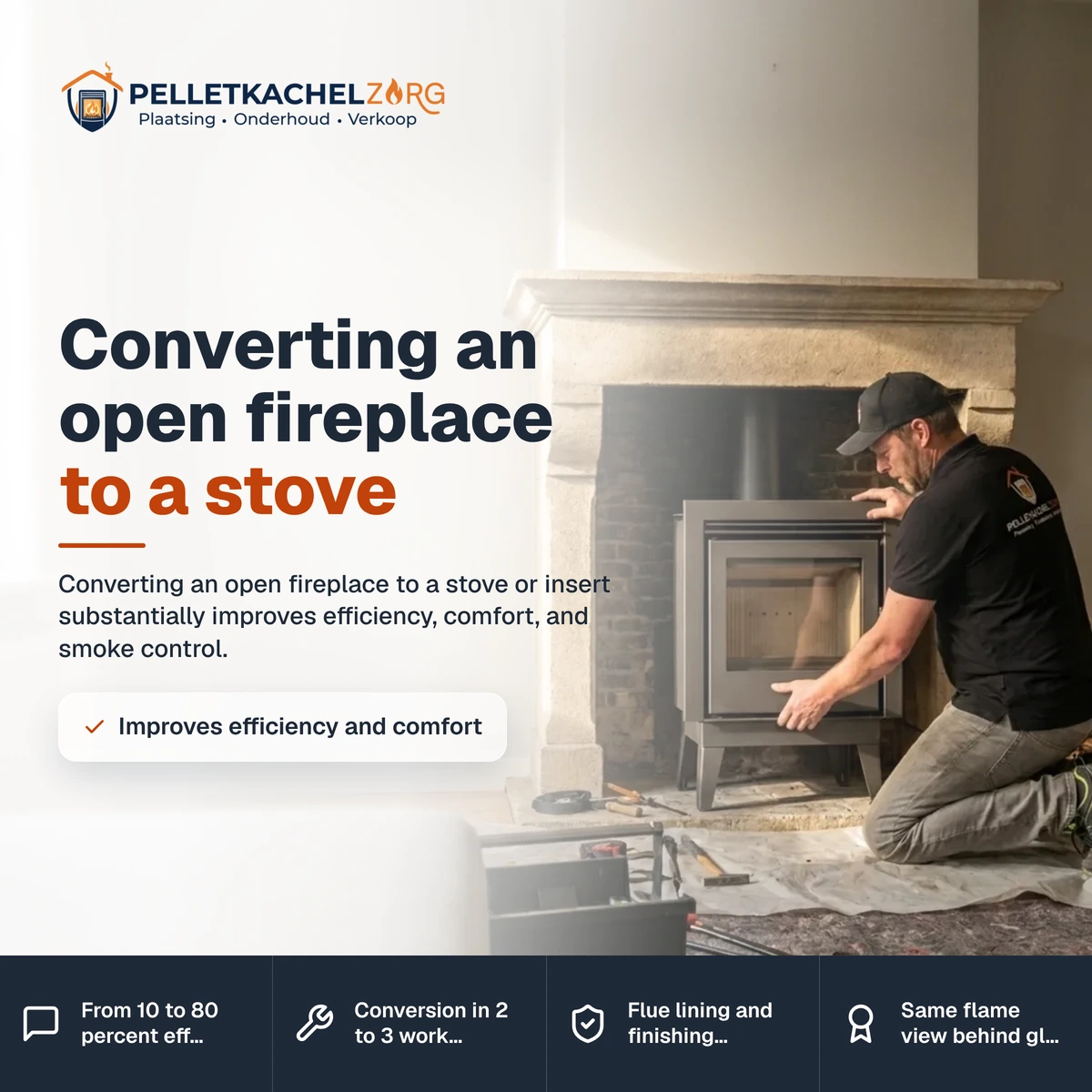
Converting an open fireplace to a stove or insert substantially improves efficiency, comfort, and smoke control.
An open fireplace is the biggest energy drain in the home: barely 10 to 15 percent of the heat stays inside, while the rest escapes through the chimney alongside your warm room air. By converting it into a closed insert stove, efficiency jumps to 75 to 85 percent, keeping the exact same cozy fire behind glass.
We complete full conversions in 2 to 3 working days: a custom insert fitted to your existing opening, a flexible stainless steel chimney liner, and complete finishing, all for a fixed price agreed upfront. Your fireplace stays in its familiar spot, but the heat finally stays in your room.
An open fireplace mostly heats the birds on the roof: an insert keeps that same beautiful fire, but delivers the heat to your side of the glass.
We measure the width, height, and depth of the fireplace opening, inspect the existing flue, and determine which insert sizes will fit. If there is any doubt about the chimney structure, our camera inspection reveals the interior condition, with the cost deducted if you proceed with the conversion. Feel free to measure the opening dimensions yourself in advance to give us a head start.
The insert must fit both the wall opening and the room size: excessive output turns your living room into a sauna, while too little forces the appliance to run constantly at maximum. We calculate the required heat output based on surface area and insulation levels, using a rule of thumb of 1 kilowatt per 8 to 10 square meters. You then choose from 2 or 3 matching models, each clearly detailed with its power output and glass size.
A flexible stainless steel liner, sized specifically for the insert, is pulled through the existing flue and connected gas-tight. We seal the old, oversized fireplace cavity neatly with fire-rated boards and insulation, incorporating convection vents to circulate heat into the room. You keep the view of the flames, while heat loss becomes a thing of the past.
We finish the surround paint-ready, guide you through the first burn with clear instructions, and provide the compliance certificate for your documentation. Your fire burns that very evening, but with heat that stays inside, and your first annual chimney sweep is scheduled right away.
The insert unit itself costs 1,500 to 4,000 euros, flue lining costs between 900 and 1,800 euros installed, and structural conversion including sealing and plaster finishing ranges from 600 to 1,500 euros. All together, a complete fireplace conversion usually lands between 3,000 and 6,500 euros, including 6 percent VAT for homes older than 10 years. For detailed lining prices, check our guide on stainless steel flue lining.
Do the math: burning 6 cubic meters of wood a year in an open fireplace only yields the actual warmth of barely 1 cubic meter. A modern insert meets that exact same heating demand using just 1.5 to 2 cubic meters, saving you up to 4 cubic meters of firewood every single year.
At current firewood prices, the entire conversion pays for itself in 5 to 8 years, and your daily comfort improves from day one: no more cold drafts pulled toward the hearth, just steady heat lingering in your home.
An open fire relies on a large, cold masonry chimney. An insert sends much smaller volumes of much hotter flue gases through that same channel. Without a lining, these hot gases condense against cold brickwork, causing creosote build-up, unpleasant odors, and serious chimney fire risks. A custom flexible stainless steel liner solves this permanently, installed via our chimney lining service within a single day, backed by a 10-year system warranty.
The strong draft of an open fireplace pulls hundreds of cubic meters of heated room air up the chimney every hour, even when using the dryest wood and best techniques. Trying to burn better in an open fire slightly reduces losses, but never yields real efficiency. You can read general burning guidelines via the official government heating advice, but true energy savings only come with the sealed glass door of an insert.
Virtually all of them: the main deciding factors are the width and height of the opening, along with the structural state of the chimney flue. Inserts come in dozens of dimensions and depths, ranging from compact 60-centimeter models to widescreen units over 80 centimeters wide, with custom frames easily covering minor sizing gaps.
In cases of severely damaged flues or unusual dimensions, we assess a full restoration path first. You receive a clear diagnosis along with complete pricing within 48 hours of our site measurement.
If you prefer switching to wood pellets, we can install a pellet insert into the same opening via our inset pellet stove installation service. If you want a larger, higher, or completely relocated fireplace on a different wall, our built-in fireplace service can design a brand-new false wall alcove from scratch. We can provide quotes for these alternative options alongside a standard conversion upon request.
Your new insert and liner require the exact same annual care as any stove: a chimney sweep costing between 60 and 90 euros plus a basic appliance check, ideally carried out together. Learn all about recommended intervals in our maintenance guide, and we will schedule your first checkup one year out upon handover.

Free survey of fireplace and chimney, fixed price within 48 hours for insert, lining, and complete finishing.
Measure first, promise second
Opening dimensions, chimney flue, and required heat output are fully surveyed before recommending a single model.
Custom flue lining as standard
Every conversion includes a stainless steel liner: preventing creosote, lingering odours, and fire hazards.
Finished ready for painting
We only leave when the surrounding wall is perfectly smooth, the test burn is complete, and certification is handed over.
The insert costs 1,500 to 4,000 euros, the stainless steel flue liner 900 to 1,800 euros, and conversion with finishing 600 to 1,500 euros: total cost usually ranges from 3,000 to 6,500 euros. For homes over 10 years old, 6 percent VAT applies.
Efficiency jumps from 10 to 15 percent up to 75 to 85 percent: the exact same amount of wood delivers roughly 5 times more heat to the room. Additionally, the insert prevents warm indoor air from being sucked up the chimney.
2 to 3 working days for the full installation: fitting the liner, connecting the insert, sealing the opening, and plastering ready for painting. You can light your first real fire the very evening after test burning.
Yes: an insert sends hotter, more concentrated flue gases through a chimney designed for open flames. Without a flexible lining, smoke condenses against cold masonry, causing creosote buildup and fire hazards. A custom liner costs 900 to 1,800 euros installed.
If you currently burn 6 cubic metres of firewood per year in an open hearth, an insert delivers the same heat output using just 1.5 to 2 cubic metres: saving around 4 cubic metres annually. At current timber prices, the conversion pays for itself in 5 to 8 years.
Modern fireplace inserts feature large, air-washed glass panes and widescreen formats well over 80 centimetres wide: the flame picture remains just as atmospheric, while heat loss is eliminated. You choose between 2 or 3 models that fit your opening perfectly.
Yes, using an insert pellet stove in the same opening: fully programmable, steady heating, and an 80 mm flexible liner through the existing chimney. During the site survey, you will receive side-by-side quotes for both wood and pellet options.
Converting open fireplaces into inserts across Belgian Limburg, Flemish Brabant, the Kempen, and Dutch Limburg.
We assess the appliance, chimney, air intake, flue gas discharge, and finishing so that the fireplace is installed safely and neatly.
Read moreInstalling a wood stove requires a correct flue pipe, sufficient draught, safe distance to flammable materials, and a suitable position in the home.
Regular maintenance keeps your wood stove safe, efficient and clean, especially with heavy use.