Tailored advice for your home
We estimate your consumption and costs based on capacity, insulation and burning hours. This gives you a realistic view instead of a generic price.
Have a pellet stove installed with the utmost care? Get a quote in 5 steps.
Have a pellet stove installed with the utmost care? Get a quote in 5 steps.
Have a pellet stove installed with the utmost care? Get a quote in 5 steps.

 Written by Dries Nijs3 min read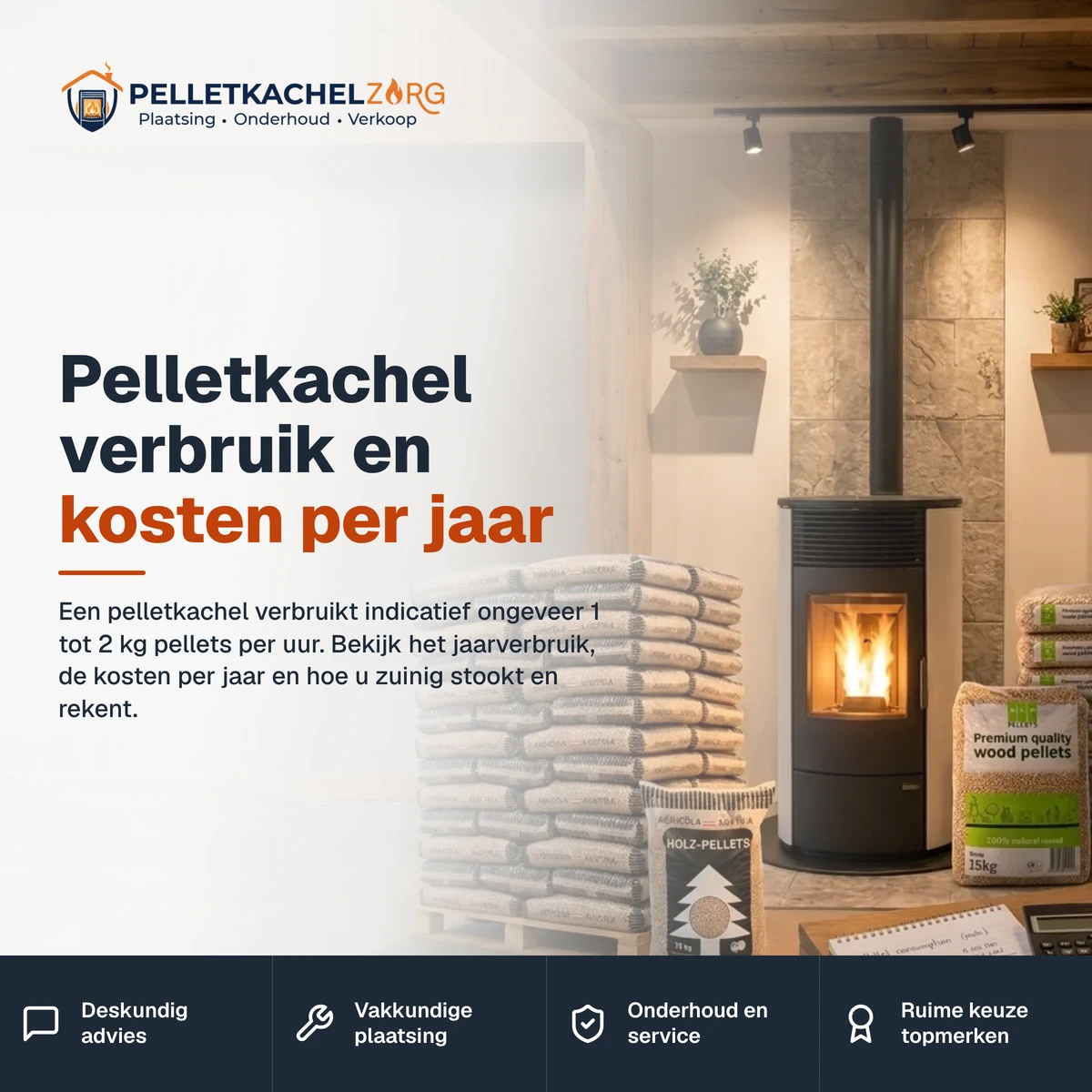
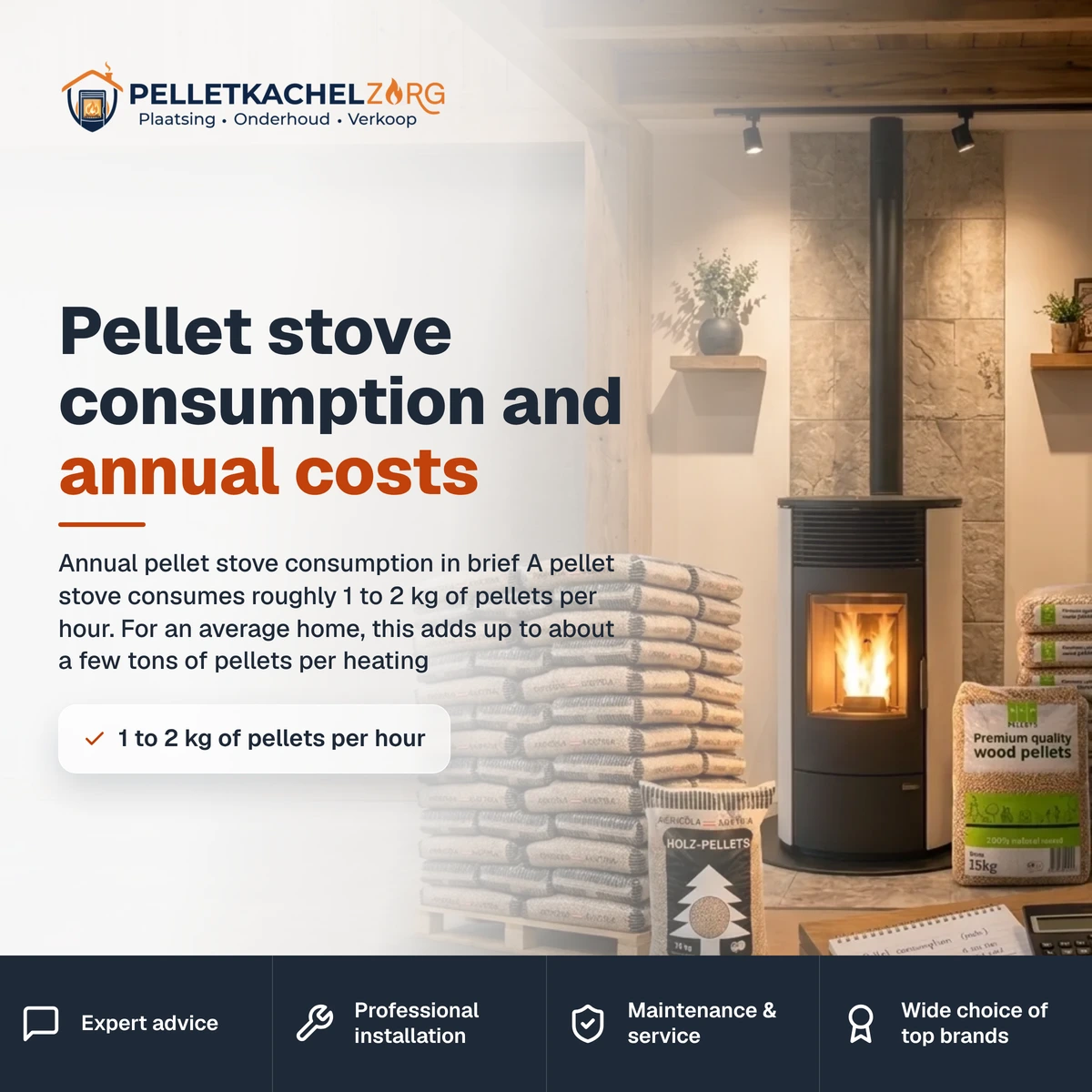
A pellet stove consumes roughly 1 to 2 kg of pellets per hour. For an average home, this adds up to about a few tons of pellets per heating season. Annual costs depend on output, insulation, operating hours and current pellet prices.
Calculate roughly using kg per hour times operating hours times pellet price, and keep a margin in mind.
Operating at average power, a pellet stove consumes about 1 to 2 kg of pellets per hour, which equals a few tons per season for a standard home. The annual pellet stove consumption heavily relies on capacity, insulation and burning hours. We will explain how to estimate your yearly usage and costs. All figures are estimates, as prices fluctuate.
With efficient heating, the stove acts as a supplement in a well-insulated room, keeping consumption low. With high consumption, the stove serves as the main heat source, often in poorly insulated homes during cold weather. Your personal situation usually falls somewhere in between.
Calculate pellet consumption by multiplying kg per hour by burning hours and pellet price, keeping the numbers as estimates.
Choose pellets with an ENplus A1 certification for stable combustion and less residue.
Store pellets in a dry place, as moisture increases consumption and pollutes the stove.
Match the stove's capacity to the room, since an oversized stove running on low wastes energy.
Service the stove annually, because a clean burner and heat exchanger maintain high efficiency.
Heat at a constant, lower setting rather than heating up quickly and intensely.
Improve insulation where possible, as this reduces annual consumption the most.
We estimate your consumption and costs based on capacity, insulation and burning hours. This gives you a realistic view instead of a generic price.
We help you choose pellets with an ENplus A1 certification. High-quality pellets keep your usage and maintenance lower.
An annually serviced stove burns fewer pellets for the same heat. We keep your burner and heat exchanger clean.
Do you know the average hourly consumption in kg of your stove
Do you track the burning hours per day and season
Are you using current pellet prices per bag or ton
Do you calculate with a margin, as prices and usage fluctuate
Do you compare pellet prices per pallet instead of single bags
Capacity plays the biggest role. A high-output stove running at full power burns around 2 kg of pellets per hour or more, while a smaller stove on a low setting stays around 0.7 to 1 kg. An oversized stove for a room often runs inefficiently on a low setting.
Insulation and burning hours are the next major factors. A well-insulated home requires fewer operating hours for the same comfort level. Naturally, leaving the stove on all day consumes more than just heating during the evening.
Your heating habits also matter. A stove running all day on a low ambient setting can use more pellets over a season than one that only heats powerfully during the coldest hours. A programmable thermostat helps you heat only when truly necessary.
Pellet quality and outside temperatures also play a part. Dry pellets with an ENplus A1 certification yield more heat per kilo and less ash. During severe frost, consumption naturally rises as the stove works harder.
If you want to know if a stove fits your space properly, correct sizing is crucial. Get advice beforehand on calculating your pellet stove's capacity and on which pellet stove suits your home, as this reduces consumption the most.
You can roughly calculate annual costs with a simple formula, kg of pellets per hour multiplied by burning hours and the pellet price. A stove consuming about 1.5 kg per hour over roughly 1500 hours will use around 2 to 2.5 tons of pellets per season.
If you estimate pellet prices around 5 to 7 euros per 15 kg bag, or roughly 300 to 400 euros per ton, you will land anywhere between a few hundred and over a thousand euros annually. The chosen capacity and home insulation explain this wide range.
If you prefer smaller calculations, a daily estimate works too. Burning about 1.5 kg per hour for around 8 hours puts you at 12 kg of pellets a day, or nearly a full 15 kg bag. Over a cold month, this easily adds up to several hundred kilos.
These numbers remain estimates, as pellet prices change with the season and market. Buying pellets by the pallet outside peak season often lowers the cost per ton. Cheap, ashy pellets will actually increase your consumption and maintenance. A quick price comparison between suppliers often reveals noticeable savings over a full season.
If you want to properly assess quality beforehand, read how you can choose the best pellets based on quality and price. If you are still deciding between heating systems, comparing between a pellet stove and a heat pump puts the annual costs into perspective.
If you want a realistic estimate of your annual consumption and costs for your specific home, we are happy to help. Request a free quote or advice and you will quickly know what to expect financially.
A pellet stove consumes roughly 1 to 3 tons of pellets per heating season, depending on capacity, insulation and operating hours. For an average home, it often hovers around a few tons per year. All figures remain estimates.
Yearly costs typically range from a few hundred to over a thousand euros, depending on consumption and prices. Estimate using a pellet price of around 5 to 7 euros per bag or roughly 300 to 400 euros per ton. Prices fluctuate.
A pellet stove uses approximately 1 to 2 kg of pellets per hour at average power. On the lowest setting, this can drop to 0.7 kg, while full capacity may reach 2 kg or more. The exact figure is listed in your manual.
You can roughly calculate the annual consumption by multiplying the kg per hour usage by the operating hours, and then by the pellet price. Keep a margin in mind, as burning hours and prices vary per season.